
EVERY year on September 16th, the world celebrates a remarkable, often unsung, environmental victory. The International Day for the Preservation of the Ozone Layer commemorates more than just a date on the calendar; it marks the signing of the Montreal Protocol, a treaty that represents humanity’s collective will to solve a planetary crisis. It’s a day to reflect on a time when we looked up at the sky, saw a problem of our own making, and, in a powerful display of global unity, decided to fix it.
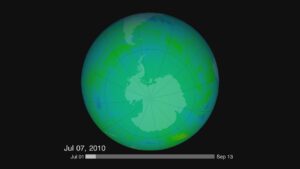
This year, the story is more hopeful than ever. Thanks to decades of determined action, NASA reports that the ozone layer is now healing. The annual ozone hole over Antarctica, a grim symbol of environmental degradation, is on a steady path to recovery, with projections indicating a full restoration by 2066. This isn’t a tale of inevitable doom, but a blueprint for hope and a testament to what we can achieve when science, policy, and international cooperation align.
The Discovery: A Looming Crisis in the Stratosphere
Our story begins in the 1970s and 80s. Scientists made an alarming discovery: the Earth’s protective ozone shield was thinning at an alarming rate. High in the stratosphere, the ozone layer acts as a planetary sunscreen, absorbing the vast majority of the sun’s harmful ultraviolet (UV) radiation. Without it, life as we know it would be impossible.
The culprits were a group of human-made chemicals known as chlorofluorocarbons (CFCs). Found in everyday items like refrigerators, air conditioners, aerosol sprays (like hairspray and deodorant), and insulating foams, CFCs were incredibly stable and useful. But that stability was their danger. Once released, they drifted high into the stratosphere, where UV radiation would break them apart, releasing chlorine atoms that proceeded to destroy ozone molecules at a devastating rate.

By the mid-1980s, the evidence was irrefutable. A massive “hole” had opened in the ozone layer over Antarctica each spring. The threat was clear: increased UV radiation would lead to skyrocketing rates of skin cancer and cataracts in humans, devastate agricultural yields, and disrupt fragile aquatic ecosystems that form the base of the global food chain. A future with a damaged ozone layer was a future of profound peril.
The Response: From Science to Global Action
Faced with this overwhelming scientific evidence, the world did something extraordinary: it came together.
The first critical step was the Vienna Convention for the Protection of the Ozone Layer in 1985. While not a binding treaty itself, it established a framework for international cooperation on research, monitoring, and future policy. It was a statement of intent, a promise to take this threat seriously.
That promise was fulfilled just two years later with the drafting of The Montreal Protocol on Substances that Deplete the Ozone Layer. Signed on September 16, 1987, this was the action the world needed. The Protocol’s principal aim was clear: to protect the ozone layer by controlling the total global production and consumption of nearly 100 ozone-depleting substances (ODS), with the ultimate objective of their complete elimination.
It was a landmark agreement, structured around a practical and flexible timetable for phasing out different groups of chemicals, from CFCs and halons to carbon tetrachloride and methyl chloroform. The brilliance of the Montreal Protocol was its recognition of a shared but differentiated responsibility—it provided a longer phase-out schedule for developing countries, ensuring the burden did not fall unfairly on those still building their infrastructure.
And it worked. Implementation of the Montreal Protocol progressed better than anyone could have hoped. Nations, both developed and developing, adhered to—and often exceeded—the phase-out schedules. Industries innovated, creating safer, environmentally friendly alternatives. The treaty proved that environmental protection and economic development could go hand-in-hand.
In a stunning show of universal consensus, on September 16, 2009, the Vienna Convention and the Montreal Protocol became the first treaties in the history of the United Nations to achieve universal ratification. Every single member state had agreed to heal the sky.
The Evolution: The Kigali Amendment and Looking Forward
But the story didn’t end there. As the world phased out CFCs, they were often replaced with hydrofluorocarbons (HFCs). While HFCs are harmless to the ozone layer, they are potent greenhouse gases, thousands of times more effective at warming the planet than carbon dioxide.
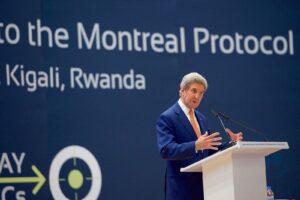
Once again, the parties to the Montreal Protocol recognized the threat and acted. In 2016, they adopted the Kigali Amendment, agreeing to phase down the production and consumption of HFCs. This single amendment has the potential to avoid up to 0.5°C of global warming by the end of the century, making it one of the most significant climate actions ever taken.
The Montreal Protocol has thus done more than just save the ozone layer; it has become a powerful climate treaty in its own right.
The Results: A Healing Sky and a Blueprint for the Future
So, where are we today? The data is overwhelmingly positive.
According to NASA and the National Oceanic and Atmospheric Administration (NOAA), the ozone layer could fully recover by 2066. The 2024 Antarctic ozone hole was the seventh smallest since recovery began in 1992. While still large—at one point reaching 8.5 million square miles—its steady shrinkage is undeniable proof that the Protocol is working.

The improvement is due to the continuing decline of harmful CFCs in the atmosphere, a direct result of the global ban. While the chemicals already released will take decades to break down completely, we have stopped the bleeding. The patient is recovering.
A Legacy of Hope
The preservation of the ozone layer is more than an environmental success story; it is a beacon of hope. It proves that:
- Science matters:We heeded the warnings of researchers and acted on the evidence.
- Global cooperation is possible:The world can unite around a common threat, regardless of politics or borders.
- Treaties work:Binding international agreements can create the framework for transformative change.
- We can solve the problems we create.
As we celebrate this International Day, we are not just looking back at a past achievement. We are looking forward. The same spirit of the Montreal Protocol—the unwavering commitment to a healthier planet—is precisely what we need to tackle the climate crisis. The hole in the ozone layer is closing. Let it be a reminder that no challenge is too great when we decide to face it together. You can support NGOs that are working for the environment by reading about them and supporting. Visit the link to know more about such NGOs in India.
The message for September 16th is simple: we did it once, and we can do it again.
Give’s mission is to “make giving bigger and better.” Give is the most trusted donation platform in India for fundraisers and crowdfunding campaigns. Through our technology solutions, we enable individuals and organisations to fundraise and donate to a cause, charity or NGO with trust and convenience. Give’s community of 2.7M+ individual donors and 300+ organisations supports 3,000+ verified nonprofits with 80G deduction and serves 15M+ people across India. Find a fundraiser today!

Kumara was a professional journalist for over 15 years, with stints in The Telegraph and Reader’s Digest. He grew up hating maths and physics. He is a post-graduate in history. Kumara believes that cricket and Seinfeld have answers to most questions that life throws at you.