
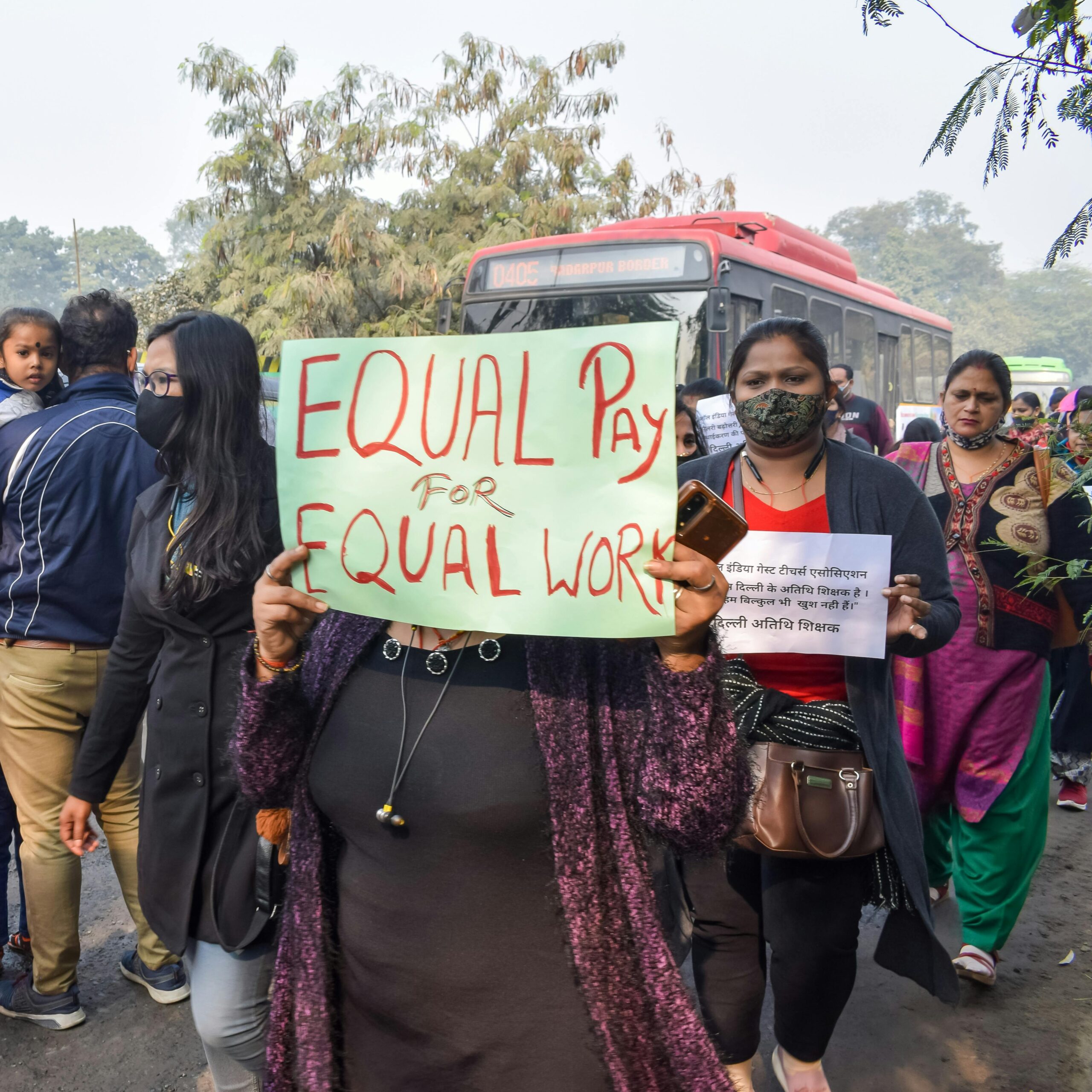
EVERY year on International Equal Pay Day, observed on September 18, the global community renews its commitment to a fundamental principle: equal pay for work of equal value. This day underscores the urgent need to address one of the most persistent forms of inequality. The gender pay gap. This continues to affect women in every region, industry, and economy.
Globally, women are paid approximately 20% less than men. In India it is far worse.Take the case of Rajamma, 27. She works as a labourer at a construction site in Bengaluru’s ISRO Layout area. She carries loads of bricks, concrete, cement etc on her head throughout the whole day. Her husband is a mason who is currently working at a different site. While males get around Rs 800 per day. Rajamma gets only Rs 550. She doesn’t know the reason and she doesn’t even complain. “I do the same amount of work as men do. And I know that pay is less for me. Women are always paid less. I don’t feel that they are doing anything bad. It is the same everywhere,” she says.
Need for fair pay
This disparity is rooted in deep-seated structural inequalities, historical biases, and disparities in access to opportunities and resources. Despite widespread endorsement of the principle of equal pay, tangible progress remains slow and uneven.
International Equal Pay Day is not just a symbolic observance—it’s a call to action. It aligns with the United Nations’ Sustainable Development Goals (SDGs), particularly those focused on gender equality, decent work, and economic growth. The SDGs explicitly advocate for “equal pay for work of equal value,” recognising that fair pay is essential to reducing poverty, promoting social justice, and building inclusive economies.
But acknowledging the problem isn’t enough.
According to the World Economic Forum, the economies with the lowest levels of economic gender parity include Bangladesh (31.1%), Sudan (33.7%), Iran (34.3%), Pakistan (36%), India (39.8%), and Morocco (40.6%). These nations all show less than 30% gender parity in estimated earned income. Furthermore, each of these economies has a labour-force participation rate parity below 50%, with Iran recording the lowest level at just 20.1%. A notable global shortcoming in gender parity remains the underrepresentation of women in the workforce, both in general and in senior and managerial positions. Parity in senior roles worldwide stands at only 40.5%, representing the lowest score across the subindex.
India has undertaken proactive legislative measures to combat pay disparity and boost women’s workforce engagement, notably through statutes such as the Minimum Wages Act (1948), the Equal Remuneration Act (1976)—since incorporated into the Code on Wages (2019)—and the Maternity Benefit Act (2017). The Equal Remuneration Act obligates employers to provide equal pay to men and women workers engaged in the same or similar work, while also barring gender-based discrimination in employment. Additionally, protections have been extended to transgender individuals under the Transgender Persons (Protection of Rights) Act (2019), which forbids employment discrimination on the basis of gender identity.
The Indian Supreme Court has affirmed that “equal pay for equal work” is a fundamental right under the Constitution. In State of Madhya Pradesh v. Pramod Bhartiya, the Court ruled this principle is inherent to the right to equality (Article 14), mandating that employees performing similar work under similar conditions must receive equal pay
But the reality on the ground tells a different story. According to a 2024 study by the Indian Institute for Population Sciences and the Tata Institute of Social Sciences, women perform the bulk of unpaid domestic work, averaging 301 minutes per day compared to men’s 98 minutes.
The World Economic Forum Report (2024) and India
According to the World Economic Forum’s report on Global Gender Gap Report of 2024, India—home to over 1.4 billion people—has closed 64.1% of its overall gender gap in 2024. Despite this progress, the country ranks 129th globally, falling two places compared to the previous year with a slight overall decline of 0.17 percentage points. This dip is largely attributed to small regressions in Educational Attainment and Political Empowerment, though there was a modest improvement in Economic Participation and Opportunity. Although India’s economic parity has improved over the past four editions, it still trails its 2012 score by 6.2 percentage points.
Key areas requiring attention include closing gender gaps in estimated earned income (28.6%), representation in legislative, senior official, and management roles (14.4%), labor-force participation (45.9%), and professional and technical roles (49.4%). In Political Empowerment, India performs well on the head-of-state indicator (40.7%, ranking in the top 10), but women remain significantly underrepresented at the ministerial (6.9%) and parliamentary (17.2%) levels. Educational Attainment is near parity, though recent data revisions show a slight decline. Enrollment rates of women are strong across primary, secondary, and tertiary education, but progress has been slow and the literacy rate gap remains wide at 17.2 percentage points, leaving India ranked 124th on this indicator.
The persistent gender pay gap in India’s tech GCCs
A recent study by TeamLealease Digital highlights a troubling paradox within India’s Global Capability Centres (GCCs). While there have been measurable advancements in gender diversity at entry and mid-level roles, a significant gender pay gap remains—and even widens—at senior levels. The overall disparity stands at 16.4% for top-tier positions, raising important questions about the true state of inclusivity and equal opportunity in these globally integrated workplaces.
The gap varies considerably across sectors. The Life Sciences and Healthcare industry shows the most pronounced inequality, with a 29.5% difference in pay, including a 23.4% gap at the senior level. It is closely followed by the BFSI sector at 26.3%. Although the technology sector boasts a relatively lower overall gap of 19%, it is not exempt from the trend; the disparity escalates to 16.3% for women in senior positions.

This inequality is further reflected in technical roles across GCCs. For instance, automotive GCCs report an average pay gap of 26.3%, while in tech the figure is 28.5%, and in BFSI it reaches 30%. The data also reveals geographical nuances: Tier 1 cities show stronger female participation compared to Tier 2 cities, though limited career growth opportunities remain a challenge across regions.
The pay gap is not limited to permanent employees. Among the contractual workforce in tech GCCs, there is a 4.4% disparity at the entry level, which increases to 6% at the mid-level. This suggests that structural inequities persist across employment types and experience brackets.
Despite these persistent challenges, many GCCs are actively working to improve gender diversity in hiring. This effort is largely driven by the adoption of global DEI policies, adherence to international workforce standards, and expansion in functional areas such as finance, human resources, and digital operations.
Several things need to change for bridge the gender gap
Meaningful change requires policy reforms, corporate accountability, and a shift in cultural attitudes. The United Nations, through UN Women and the International Labour Organization (ILO), urges governments, businesses, civil society organizations, and communities to take concrete steps toward pay transparency, equitable hiring practices, and the economic empowerment of women and girls.
This International Equal Pay Day, let’s move beyond awareness and into action. Let’s challenge pay discrimination, support legislation that enforces wage fairness, and celebrate organizations that lead by example. Achieving equal pay isn’t just a milestone for gender equality—it’s a milestone for human rights.
As we mark International Equal Pay Day, we’re reminded that equal pay is essential not only for women’s empowerment but for the well-being of families, communities, and economies worldwide. The path to pay parity is long, but together, progress is possible.

Give exists to alleviate poverty by enabling the world to give. Established in 2000, Give, together with its partners, is the largest and most trusted giving platform in India. Give enables individuals and organizations to raise and donate funds conveniently to any cause they care about, with offerings including crowdfunding, corporate giving, cause marketing, and philanthropy consulting. Give’s community of 2.6M+ donors supports 3,000+ verified nonprofits, serving 15M+ people across the country.