
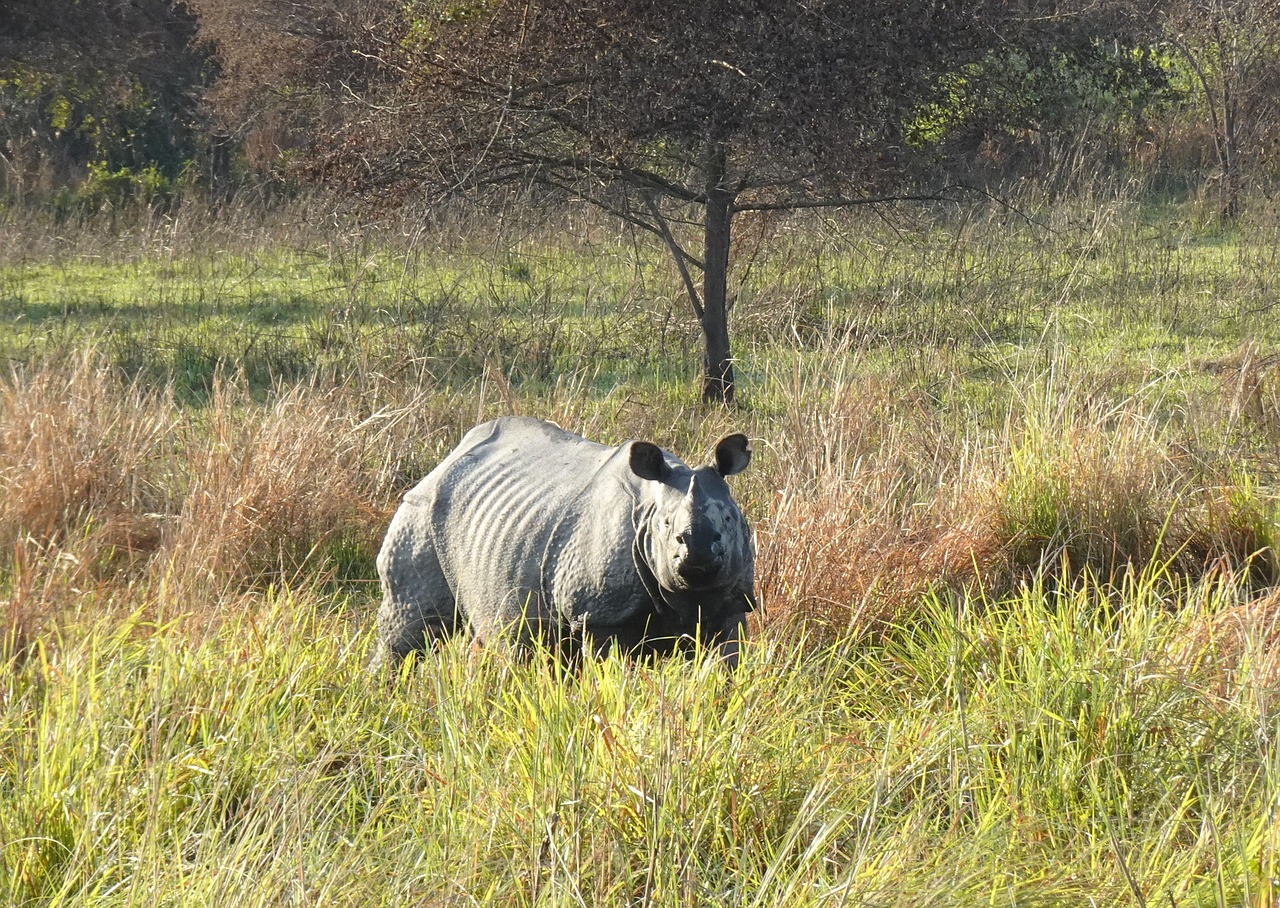
THE World unites every year on September 22 to celebrate World Rhino Day. It is a day for celebration and reflection. This day honours the majestic rhinoceros. It is also the day that talks about critical threats they face. Rhinos worldwide face poaching and habitat loss and also suffer the effects of the escalating climate crisis. Yet amidst these challenges, there are beacons of hope. Stories of resilience prove extinction is not inevitable.
This World Rhino Day, we focus on an incredible success story. It is the revival of the greater one-horned rhinoceros. The heart of this effort is Assam, India. The greater one-horned rhino is the largest of the three Asian rhino species, and the other two are the Javan and Sumatran rhinos. It has a single black horn and armour-plated skin. This gives it a prehistoric appearance. Adults can weigh up to 2,800 kg. They are mega-herbivores and they play a crucial role in shaping their ecosystem.
Their grazing maintains floodplain grasslands. It prevents woodland encroachment. This ensures other herbivore species survive. Their wallowing behaviour creates waterholes. These waterholes benefit countless other animals. This is especially true in dry seasons. Losing the rhino would unravel these rich ecosystems.
Historically, the rhinos roamed northern floodplains of the Indian subcontinent. But by the early 20th century, hunting was rampant and the habitat loss was severe. These factors pushed them to the brink and their numbers plummeted to a terrifying 200 only. Their last stronghold was the state of Assam where the rhinos were brought from the brink to a thriving species.
Protected areas for rhinos in India
India has established a network of eight protected areas dedicated to the conservation of the greater one-horned rhinoceros, comprising five National Parks and three Wildlife Sanctuaries. The state of Assam is the primary stronghold, hosting five of these areas—Kaziranga National Park, Orang National Park, Manas National Park, Pobitora Wildlife Sanctuary, and Laokhowa Wildlife Sanctuary. West Bengal contributes significantly with two protected areas, Jaldapara Wildlife Sanctuary and Gorumara National Park, while Uttar Pradesh’s Dudhwa National Park is home to a few rhinos.
Laws to protect rhinos
The central government has enacted the stringent Wildlife (Protection) Act, 1972, established the Wildlife Crime Control Bureau, and provides financial support through schemes like Project Tiger and Project Elephant. India also reinforces its commitment through international cooperation as a signatory to CITES and via bilateral agreements with neighbors like China and Nepal. At the state level, conservation is driven by intensive patrolling, inter-agency coordination, equipping frontline staff, and conducting awareness campaigns to foster local community cooperation in the fight against poaching.
Why rhinos are important for ecology
The Indian rhinoceros is a keystone species, playing an indispensable role in maintaining the health and balance of its ecosystem. As mega-herbivores, their grazing patterns are crucial for engineering the grassland and wetland habitats they inhabit. By feeding on both short and tall grasses, they prevent woody plant encroachment, effectively acting as natural landscapers who maintain open grasslands for other herbivore species. Furthermore, their constant wallowing in wetlands and waterbodies helps to naturally rejuvenate these aquatic systems, preventing siltation and creating waterholes that benefit countless other animals. The loss of rhinos would trigger a cascade of negative effects, fundamentally altering the structure and function of these vibrant ecosystems.
Assam: The unlikely ark
Today, Assam is home to over 4,000 rhinos. This is about 80% of the global population. This recovery is staggering. It is a 170% increase from the 1980s. Then there were roughly 1,500 rhinos. It is a bounce back from the 1960s. Then there were merely 600 survivors. This is no accident. It results from over a century of effort.
The Government of India, in collaboration with the Assam state government, has spearheaded several key conservation initiatives that form the backbone of the rhino’s recovery. A cornerstone of this effort is the National Conservation Strategy for the Indian One-Horned Rhinoceros (2019), launched by the Ministry of Environment, Forest and Climate Change. This comprehensive strategy aims to systematically repopulate historical rhino habitats by augmenting existing efforts through targeted scientific and administrative measures. The groundbreaking Indian Rhino Vision (IRV) 2020 programme focused on expanding the animal’s distribution and genetic diversity by strategically translocating rhinos to suitable, protected habitats like Manas National Park.
The success of Kaziranga
The impact of the sustained government efforts is undeniable. As of 2022, Kaziranga National Park, a UNESCO World Heritage Site, is home to 2,613 rhinos, a figure that reflects decades of effective protection and management. This success means Assam now safeguards approximately 68% of the global population, underscoring the state’s pivotal role in the species’ survival. Furthermore, the government has integrated community engagement into its strategy, with initiatives like World Rhio Day celebrations in Kaziranga helping to raise public awareness and foster a collective sense of responsibility towards protecting this iconic species.
The Kaziranga Model: A blueprint for success
Kaziranga National Park is the crown jewel. It had 2,613 rhinos at the 2022 census. The Naitonal Park holds nearly 70% of Assam’s rhino population. In other words, it is the most important site for the species on Earth. The “Kaziranga Model” is a multi-faceted approach.
Assam’s forest guards show unparalleled dedication. These men and women operate with military discipline. They face immense danger with even engagement in armed confrontations with poachers. They have also made the ultimate sacrifice in protection of rhinos. Their high-frequency patrolling is pivotal. Their intelligence gathering helps. They use modern technology like drones. It is important to remember these courageous individuals on World Rhino Day.
A zero-tolerance policy is key. Assam’s government is uncompromising against poaching. This was shown symbolically in 2021. The government burned 2,479 recovered rhino horns. This historic event was watched by millions. It sent a clear message. The horn has no commercial value. Its only value is on a living rhino. This policy has strong legal backing. Laws range from an 1891 Act to the 1972 Wildlife Act.

Scientific Management and Habitat Expansion are crucial
Conservation needs space for growing populations. Assam has expanded protected areas aggressively. Orang National Park grew by over 200 sq km. Laokhowa-Burachapori Wildlife Sanctuary was reclaimed for rhinos. New parks like Siknajhar were declared. This created a network of safe havens. This was part of Indian Rhino Vision 2020. It translocated rhinos to repopulate parks like Manas.
Community engagement and eco-tourism play a role. Kaziranga’s success is an economic story. It became an iconic tourist destination. It generates significant revenue. Local communities now see the living rhino as valuable. This economic incentive helps. Awareness programs also help. Both mitigate human-wildlife conflict. They turn communities into conservation allies. Prime Minister Narendra Modi recently visited Kaziranga. He interacted with forest guards. This boosted national pride and awareness.
The road ahead: Persistent threats and new challenges
Despite phenomenal success, work remains. Increasing rhino numbers bring new challenges.Illegal trafficking is a big threat. Demand for rhino horn remains. This is especially true in Southeast Asia. Poaching in Assam has declined drastically. It fell from over 50 per year to just a few. But horn prices are astronomical on the black market. So the threat is perpetual. Rhino products account for 29% of trafficked wildlife goods globally.
Habitat management is critical. Populations near carrying capacity in Kaziranga. Managing grasslands is essential. Ensuring sufficient space is key. Invasive species like water hyacinth are a threat. They degrade grassland quality.
Human-wildlife conflict is growing. Rhino populations are expanding. Animals move outside park boundaries. They enter villages and farmlands. This leads to crop damage. It poses potential danger to human life. Creating secure corridors is essential. Effective mitigation strategies are needed.
Climate change is a major risk. Kaziranga is defined by the Brahmaputra River. Floods are becoming more intense and frequent. This is a predicted impact of climate change. It poses a significant risk to fauna. Floods force animals onto dangerous highlands. They also push them into human settlements.
A Pledge for the future
On this World Rhino Day, Assam’s story is powerful. It shows what is possible and it is a story of political will and extraordinary bravery by forest staff. It is about a community embracing its pachyderm neighbours.
The rhino’s journey is incredible. It came from the brink of oblivion. and now it has a thriving population. This is one of India’s greatest conservation achievements and it serves as a model worldwide. The whole effort inspires rhino conservation everywhere. As we celebrate, as Indians, we must renew our pledge to efforts in Assam and beyond. We must ensure the rhino thrives for millennia.
You can support NGOs that are working for wildlife in India. Here are some NGOs.

Kumara was a professional journalist for over 15 years, with stints in The Telegraph and Reader’s Digest. He grew up hating maths and physics. He is a post-graduate in history. Kumara believes that cricket and Seinfeld have answers to most questions that life throws at you.