
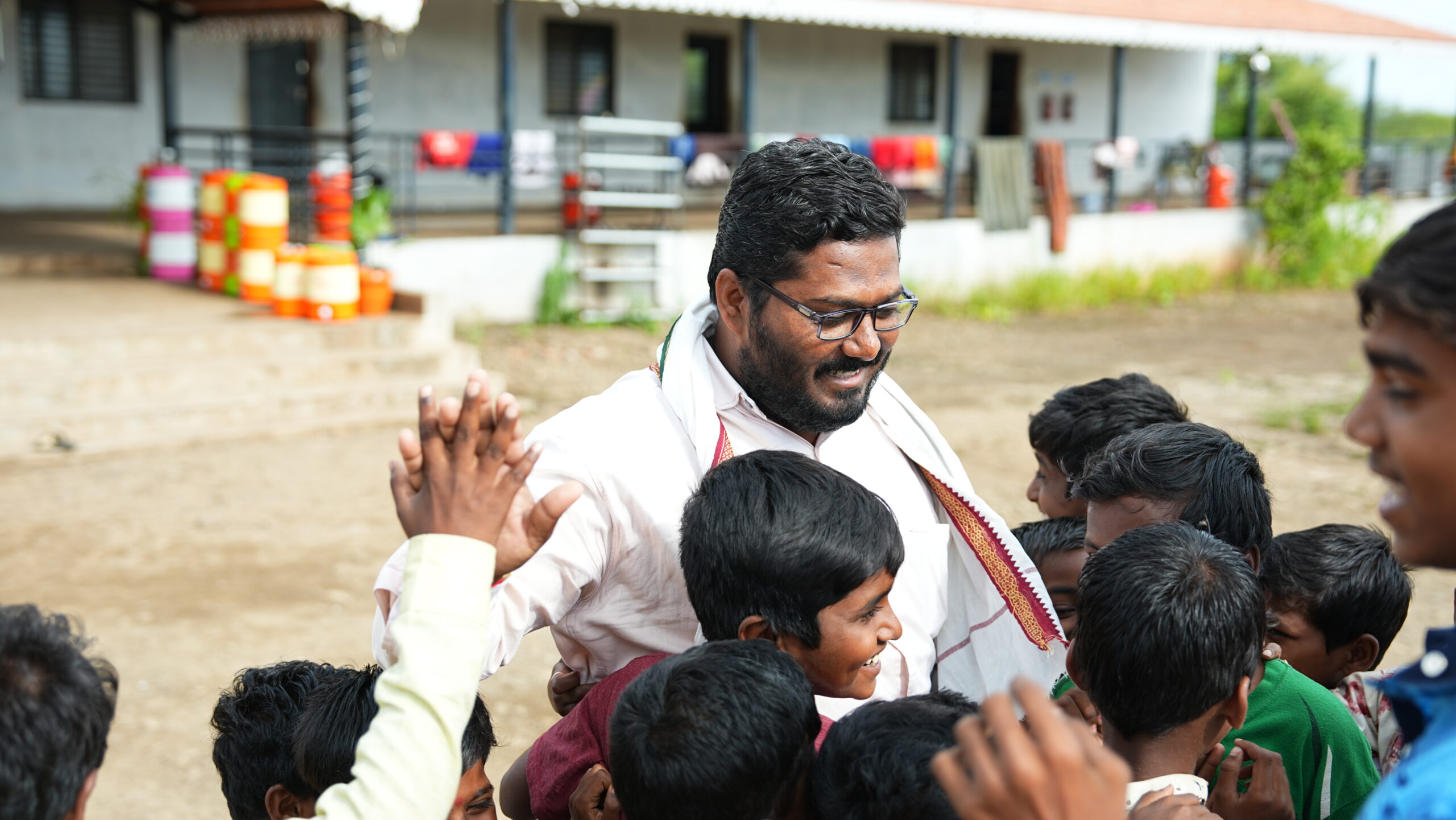
In the bustling streets of our cities and the quiet corners of our villages, two segments of society suffer in silence, often invisible to the hurried eyes of the world. On one end of the spectrum are the elderly, parents who spent their youth building homes, only to be turned away from them in their twilight years. On the other end are the children—orphaned, destitute, or born into poverty so crushing that their childhoods are stolen before they even begin.
These are the “unwanted.” The burden. The forgotten.
But for Prasad and his wife Anu, they are family. In a world that often looks away, Prasad looked closer, driven by a personal history of pain that would have broken most men. Instead, it built the Prarthana Foundation Irelawadi, a sanctuary that is now home to over 45 children and dozens of abandoned seniors.
A childhood lost to debt
To understand why Prasad drives an auto-rickshaw day and night to feed strangers, you have to understand the hunger he felt as a boy. Prasad’s story begins in the heart of India’s agrarian crisis.
“When my father ended his life due to farm debt, I was 14 years old, and I was in the ninth grade,” Prasad recalls, his voice heavy with the memory of that day. At an age when a boy should be worrying about exams or cricket, Prasad was thrust into the role of the head of the family. The trauma wasn’t just emotional; it was immediate and physical. “We had to sell everything. We had to sell every cow… We faced a lot of difficulty”.
The passing away of a breadwinner often leaves a family destitute, and Prasad’s family was no exception. “The situation was such that we did not have food to eat,” he says. His mother was forced into daily wage labor, plowing fields to earn a meager income that came only once a week. “We would fill our ration once, and that ration would finish by the next week. So, we had to struggle a lot even for food”.
Perhaps the deepest scar left on young Prasad was not the poverty, but the isolation. In their darkest hour, the community turned its back. “We thought that some people in our surroundings would help us. But no one helped us. Everyone drove us away,” he remembers. “They drove us away because… they thought we would ask them for money”.
Turning grief into a sanctuary
Prasad survived those years because of his mother’s strength, but the scars remained. As he grew older, he made a vow. “From my personal experience, I wanted to do this because the suffering I endured in life, I did not want other children or people to go through it”.
Life, however, had more tests in store. Prasad faced the heartbreaking loss of his own 2-year-old daughter. It was a shattering blow, the kind of grief that can consume a person. But for Prasad and Anu, this personal tragedy became the catalyst for a broader mission. They decided to channel the love they had for their lost child into the children who had no one.
“We decided that now we should create a residential project,” Prasad explains. He took a loan, bought a small house, and opened his doors to the victims of suffering, children of farmers who had committed suicide, children begging on footpaths, and those from shattered families.
The two ends of life: Abuse and Abandonment
Today, the Prarthana Foundation is a unique ecosystem where the abandoned elderly become grandparents to orphaned children. But the stories of how they arrive at the shelter are harrowing.
Prasad shares the story of Laxmi, an elderly woman whose golden years turned into a nightmare. “Her son beat her a lot because he was an alcoholic… he would ask for that money from her salary, the old-age pension she receives”. The cruelty was relentless. “If she did not give it, he would beat her, and he would not give her food. Whatever came to hand… they would beat her with whatever came to hand”.
Eventually, the woman who gave birth to them was thrown out. “For three days, she stayed on the footpath in the village. I got a call from the village people that, ‘Sir, there is an old woman sitting here, she is begging for food'”.
When these elderly parents arrive at the shelter, they are broken not just physically, but spiritually. “They feel very ashamed. Their self-respect reduces a lot,” Prasad notes. “They feel lonely. Sometimes, they cry alone”.
On the other side are the children. Prasad speaks of a boy named Sidhu, whose parents used him as a tool for begging. “They make him sell photos and beg by taking him to different villages,” Prasad recalls telling the parents. “You have lived your life by begging until now, but he should not beg in the future”.
Without intervention, the future for these children is bleak. “If those children… did not get a safe house… their future would be ruined,” Prasad warns. “Some children will steal, some will become child laborers… they will become criminals”.
A home, not an institution
What makes Prarthana Foundation different is that it is not run like an institution; it is run like a large, loving family. Prasad and Anu have sacrificed their careers to be the parents these children lost.
“In the beginning, we both used to work… But later… my wife quit her job,” Prasad says. To fund the shelter, he took to the streets. “I bought an auto-rickshaw, and I used to drive the auto-rickshaw day and night in Solapur”. While he drove, Anu started a canteen (mess) to generate income. Every rupee earned went into feeding and clothing the residents.
The impact of this love is palpable. “When the children come here to us, they feel safe,” Prasad says with a smile. “All the children call Anu and me Aai (mother) and Baba (father)… This is the true earning of our life”.
For the elderly, the shelter offers a second chance at dignity. The woman who was beaten by her son now finds peace. “She feels that, ‘My son beat me… But today, she considers me her son'”.
The fear of tomorrow: An urgent appeal
Despite the love that fills the shelter, the reality of running such a large home is a daily struggle. Prasad and Anu are fighting a constant battle against running out of resources.
“Running this big house by driving an auto-rickshaw or with a little bit of help is very difficult,” Prasad admits. “There is always a fear that if the money runs out tomorrow, what will happen to these children and elderly people?”.
The needs are basic but expensive. With 45 growing children, the cost of education and nutrition is high. “The donations we receive, we spend that money on the children’s education… And we buy good quality ration for the food we feed them”. Healthcare is another major expense, as many elderly residents arrive paralyzed or sick, and children often come from backgrounds of malnutrition.
Prasad has a vision for the future, a school within the campus, a skill training center for the older children, and a fully equipped medical room for the seniors. But he cannot do it alone. He cannot drive the auto-rickshaw enough hours in a day to build this future by himself.
“I want to appeal to you people that all these elderly people and children are your own,” Prasad pleads. “Please support us, donate, with the thought that even your small help can change the life of these children and elderly people”.
Prasad and Anu have opened their hearts and their home. They have healed the wounds of the past by saving the future. Now, they need us to help them keep the lights on, the kitchen running, and the hope alive. To support the unique home click here
Choosing to tread the proverbial road less travelled, Ramon embarked upon a career in journalism and spent over 8 years working for various media organisations. A deeper calling to create a sustainable impact in the lives of the less fortunate compelled him to join the social sector. Ramon is a minimalist at heart and an explorer in spirit.
Discover more from
Subscribe to get the latest posts sent to your email.