
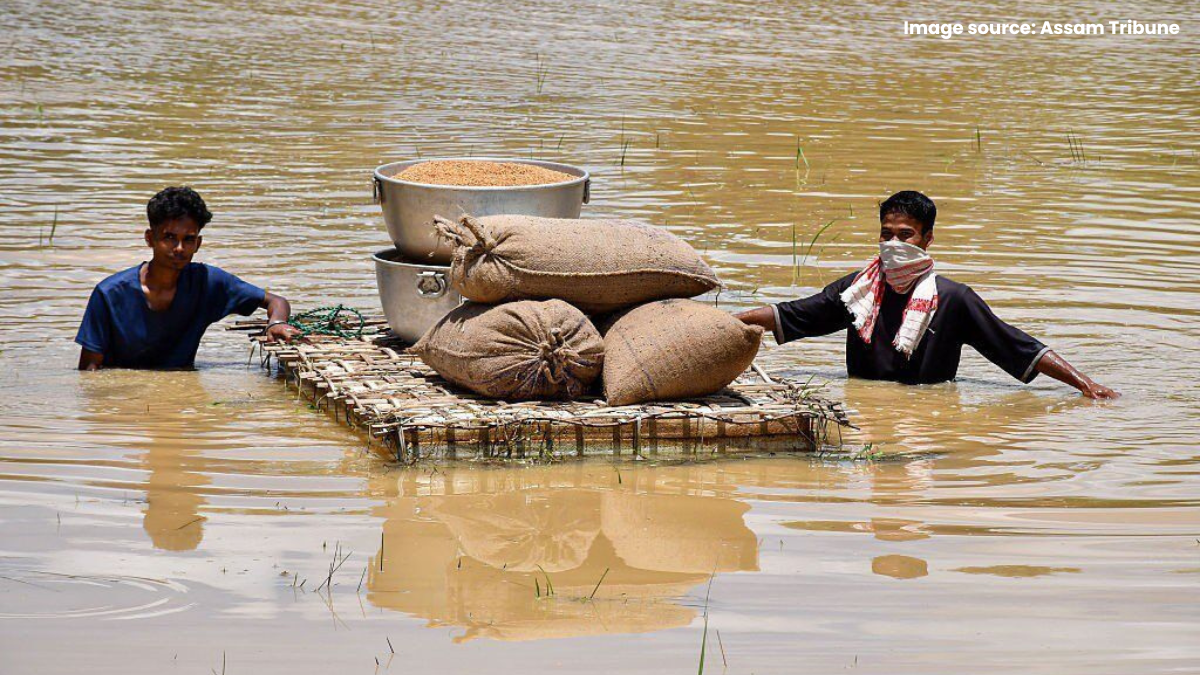
The Dhansiri river at Numaligarh is still flowing above the danger mark. That single fact explains more about the current Assam floods than any headline about receding waters.
As of 29 July 2026, the death toll has reached 75. Around 3.32 lakh people remain affected across seven districts, Sivasagar, Charaideo, Golaghat, Jorhat, Nagaon, Sonitpur and Kamrup Metropolitan. Charaideo alone accounts for nearly 1.43 lakh of them. More than 600 villages are still dealing with the aftermath. Over 32,000 people are living in 81 relief camps.
The water is going down in many places. The danger is not. A meanful contribution from you can help a family survive. Click the link now.
What the numbers do not show
Floods in Assam do not end when the rivers fall. They leave behind ruined paddy fields, silt-covered homes, dead livestock and contaminated wells. Earlier reports put the submerged crop area at over 37,000 hectares. Tens of thousands of animals were washed away. Families who depend on a single harvest or a few cattle have lost both.
In villages like those in Nazira and Sonari, the immediate scramble is for dry ground, clean water and a place to sleep that is not shared with dozens of others. Hygiene kits, basic medicines and cooking utensils become the difference between coping and collapse.
The threat that remains after the water leaves
The Indian Council of Medical Research has already warned of the usual post-flood pattern: water-borne illnesses such as typhoid, jaundice and dysentery, and the rise of vector-borne disease once stagnant water creates breeding grounds. Disinfection drives are under way, but they cannot reach every household at once.
Roads and embankments are damaged. Power is still being restored in phases. Children have lost books and uniforms. The monsoon is not over. Another spell of heavy rain could push rivers up again, particularly where the Dhansiri remains high.
This is the stage where public attention usually fades. The dramatic images stop. The quiet work of keeping people fed, healthy and housed begins.
How support reaches the ground
Organisations already present in the worst-hit pockets are distributing food, shelter materials, hygiene supplies and first-aid items to vulnerable households, including tribal, minority and fishing communities. ActionAid is among those working in Sonari and Nazira. The scale of need still exceeds what any single effort can cover.
Every contribution that arrives now goes toward the unglamorous but essential items: rations that last beyond the next two days, tarpaulins that keep families dry while they wait for houses to be assessed, soap and water purification that reduce the disease risk the ICMR has flagged.
What donors can actually do
The most useful response is not sympathy. It is money that converts quickly into the things people on the ground have already listed as shortages. Cash lets local teams buy what is available in the nearest market rather than waiting for truckloads from elsewhere. It also lets them adjust when the needs shift from rescue to recovery.
The Assam government has announced additional ex-gratia payments and interim cash support for severely affected families. That helps. It does not replace the gap that remains for households still outside formal relief systems or those whose losses will only become fully visible once the assessment teams finish their work in early August.
If you have been looking for a clear way to help Assam flood victims, this is the window. The rivers are falling. The crisis is not finished. Support that reaches families now determines how many of them get through the next two months without sliding further into debt or illness.
Donate through verified channels. Share the need with people who still think the floods are already over. The difference between a short news cycle and a sustained recovery is measured in exactly these days.

Choosing to tread the proverbial road less travelled, Ramon embarked upon a career in journalism and spent over 8 years working for various media organisations. A deeper calling to create a sustainable impact in the lives of the less fortunate compelled him to join the social sector. Ramon is a minimalist at heart and an explorer in spirit.