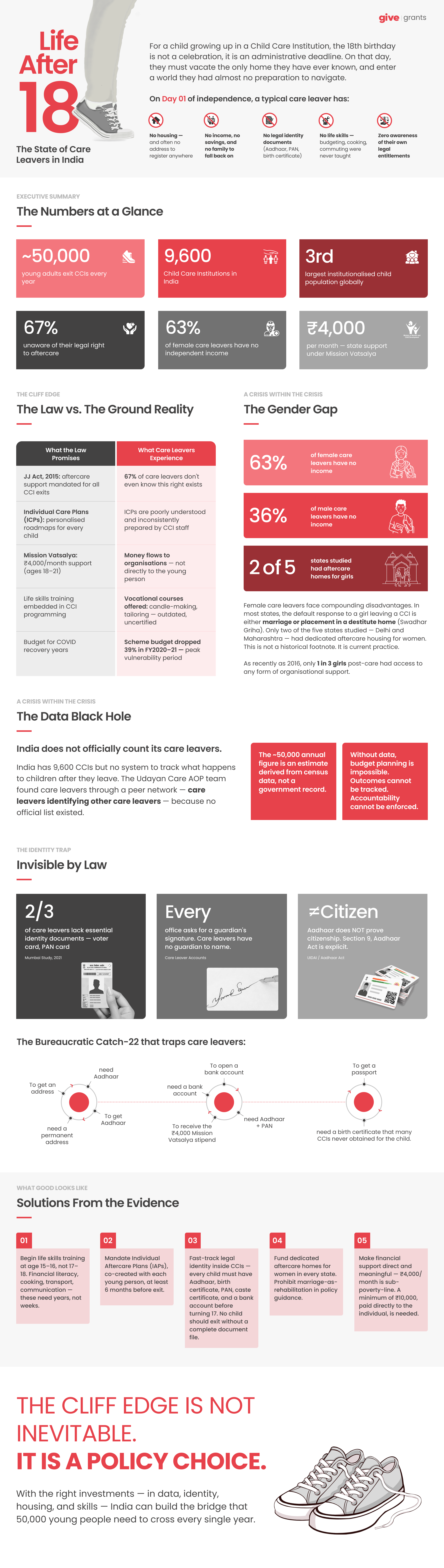

Every year, approximately 50,000 young adults walk out of India’s Child Care Institutions. On that day, the state’s responsibility ends. No housing, no income, no identity documents, no family to fall back on. For care leavers in India, turning 18 is not a milestone. It is a cliff edge.
This report maps what happens next — the gap between what the law promises and what young people actually experience when they leave care. It draws on over a decade of research, policy analysis, and ground-level evidence to examine why that gap has remained this wide, and what it will take to close it.
The Scale of the Crisis
India has 9,600 Child Care Institutions and the third-largest institutionalised child population in the world. Yet 67% of care leavers don’t know they are legally entitled to aftercare support. Nearly half remain financially dependent after leaving care. Among those who do find work, 93% earn between ₹7,500 and ₹8,500 a month — a wage that falls below subsistence level in any Indian city.
A System That Fails at the Threshold
The Juvenile Justice Act, 2015 mandates aftercare support for all CCI exits. Mission Vatsalya promises a monthly stipend of ₹4,000 for young adults aged 18 to 21. In practice, most care leavers never access either — because they lack the foundational documents needed to claim them. Two in three exit without a voter card or PAN card. The catch-22 is stark: to get Aadhaar, you need a permanent address. To get an address, you need Aadhaar.
The Gender Dimension
The disadvantages compound for young women. 63% of female care leavers have no independent income after leaving care, compared to 36% of male care leavers. In most states, the system’s default response to a girl leaving a CCI is not opportunity — it is early marriage or placement in a destitute home. Of the five states studied, only two had dedicated aftercare housing for women.
Ground-Up Solutions and the Road Ahead
The most promising responses to this crisis are not coming from government ministries. They are being built by people who have lived through the cliff edge themselves. CLiC — founded by a care leaver in Jaipur — built Rajasthan’s first verified care leaver database in partnership with UNICEF. Udayan Care’s Aftercare Outreach Programme has placed over 200 young people in employment across five states. These are not pilots. They are proof of what targeted, community-rooted support can do.
The report sets out eight evidence-backed steps — from securing legal identity documents inside CCIs before a young person turns 17, to formally recognising ‘care leaver’ as a distinct vulnerable category in national policy.
The cliff edge is not inevitable. It is a policy choice. And policy choices can be changed.
Infographic