
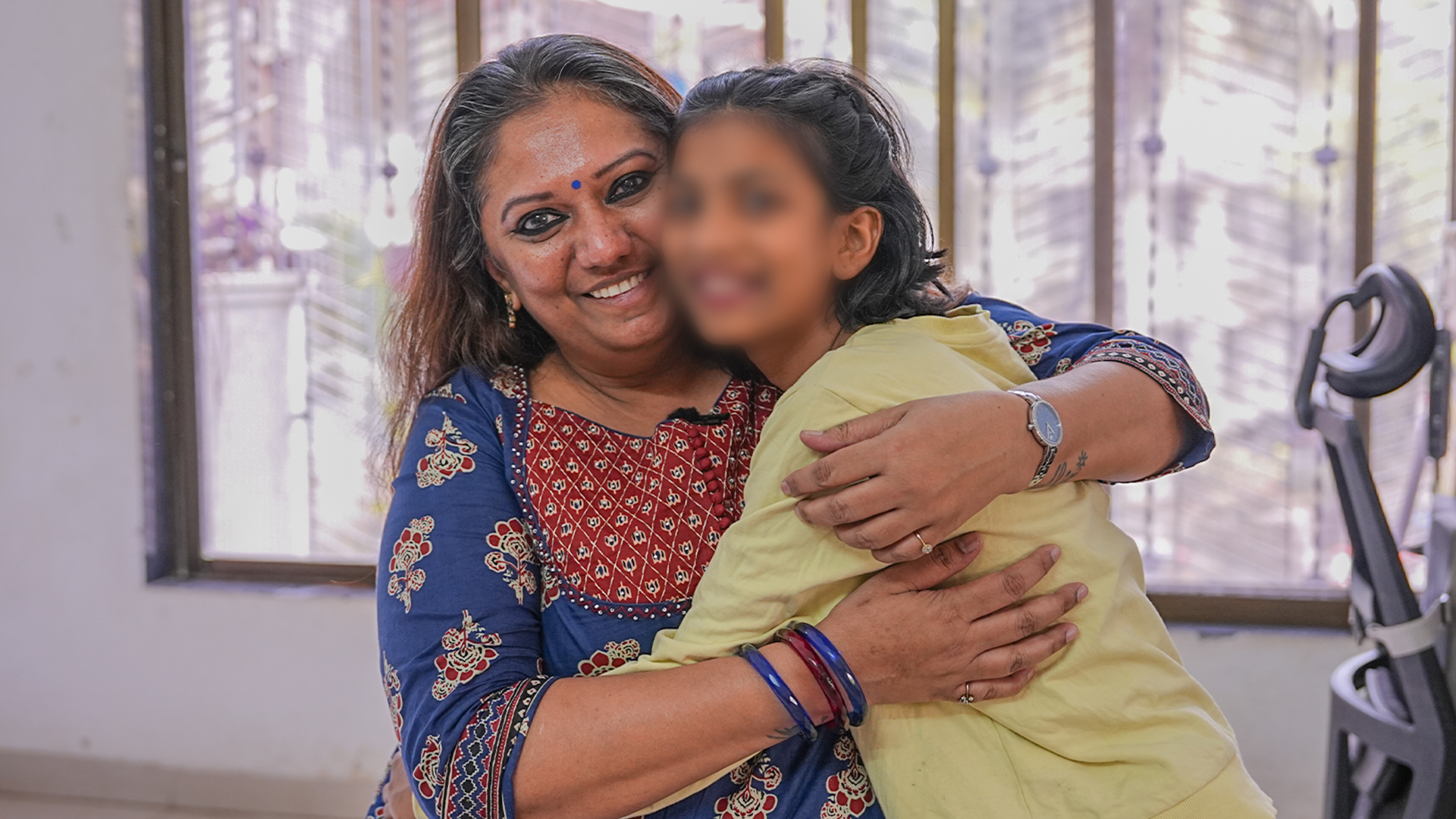
“Nobody is going to give you money for this. Because it is a lost cause.” That’s what people told Mansi Shah when she started Happy Feet Home, an NGO that works with children living with HIV, thalassemia, cancer and other life-limiting illnesses. Years on, Happy Feet Home is proof that they were wrong.
Most fundraising conversations avoid children who might not survive. Happy Feet Home was built for exactly them. “If I start something, I will work with children who have illnesses which may not have a cure,” Mansi says. “Who are probably not going to make it. That’s when the idea of Happy Feet Home came into my mind.” To know more and show your support click here.
Who are the children at Happy Feet Home?
The children here rarely arrive with just one problem. “It’s not 1, not 2, but 3 or 4 issues that they are grappling with in life,” Mansi explains. Many of the children living with HIV are also orphans, having lost their parents to AIDS. All of them come from extremely low-income households.
One family took in five more children after losing a relative to illness, turning a household of five into a household of ten, running on daily wages. It’s the kind of arithmetic that doesn’t show up in a donation appeal easily, but it’s the everyday reality Happy Feet Home works around.
Some children arrive as teenagers having never been held. “Even children who came at 15, 16, 17 said the first time anybody held them, anybody hugged them, was at the centre,” Mansi recalls. That single line says more about neglect and isolation than any statistic could.
Why did people call this a lost cause?
Because the maths of traditional charity rewards recovery stories, and these children don’t always get one. A three-year-old girl with a brain tumour, whom Mansi had grown close to, was eventually sent home when doctors could do no more. “Just before the train started, she squeezed me. She gave me a tight hug. And it felt like that was a final goodbye,” Mansi says. Where the girl lived, there were no hospitals nearby. No morphine. No painkillers.
Another boy, 16 years old, passed away, and his father couldn’t afford the hospital dues to release his body. “Imagine his mother not being able to grieve, because she does not have his body,” Mansi says. It’s not a line written for effect. It’s what happens when illness and poverty collide without any safety net in between.
What does Happy Feet Home actually do?
The centre runs on a few unglamorous but essential programmes. A medical support programme procures medicines so children aren’t suffering simply because a family can’t afford treatment. A nutrition programme cooks four balanced meals a day, and children can eat as much as they want.
Then there’s the part that doesn’t fit neatly into a budget line: affection. “At Happy Feet Home we make sure that children receive love and affection in abundance,” Mansi says. “That they are not robbed of the joy.” Staff describe small, specific gestures, like arranging pav bhaji because a child asked for it that day, as some of the most meaningful work they do.
A team member put it plainly: “Happy Feet Home is not an organisation. Happy Feet Home is a home.” She adds that the children “have finally found a space that does not judge them, that does not have biases, that does not discriminate.”
What happens when a child gets better?
This is where the “lost cause” framing falls apart. A boy arrived at the centre at 12, weighing just 17 kilos, with no parents, largely living on the street. He was hospitalised almost every Friday. Today, he plays cricket professionally and carries a 19-kilo kit bag to matches.
A girl with an HIV viral load of 35 lakhs, once told by doctors that she might not live long, is now 17. She’s healthy, in college, and learning capoeira. Her viral load is zero. Another girl living with thalassemia, HIV and a thyroid condition, who takes 14 to 15 medicines daily, now does yoga, dances and lives, in Mansi’s words, “like an absolutely regular teenager.”
These aren’t outliers dressed up for a campaign. They’re what consistent medical care, nutrition and affection can do for children written off elsewhere.
Why does this work still need support?
Because none of it runs on hope alone. “The hardest financial call I had to take was when we shut the centre down for almost two weeks because of lack of funding,” Mansi says. In that gap, “children did not have nutrition, children didn’t get education, children didn’t get mental health support.”
Illnesses like HIV and thalassemia don’t resolve on their own. Medicine, treatment and care are what the founder calls a forever need, not a one-time fix. That’s the argument for monthly giving over a single donation: consistent illnesses need consistent funding, not a spike of attention followed by another shutdown.
How can you support Happy Feet Home?
If you believe children with HIV, thalassemia or cancer have a right to a dignified life, Happy Feet Home is one of the NGOs you can support directly through Give.do. [link: Give.do donation page for Happy Feet Home]
A donation here doesn’t just cover medicine or a meal. It’s what lets a 3-year-old girl get held before anyone else has ever held her, what let a 17-kilo boy grow strong enough to carry a kit bag heavier than he once weighed. As Mansi puts it, as a donor, “you are not only giving money. You are ensuring that children with illnesses have the right to live as children.”
Choosing to tread the proverbial road less travelled, Ramon embarked upon a career in journalism and spent over 8 years working for various media organisations. A deeper calling to create a sustainable impact in the lives of the less fortunate compelled him to join the social sector. Ramon is a minimalist at heart and an explorer in spirit.