
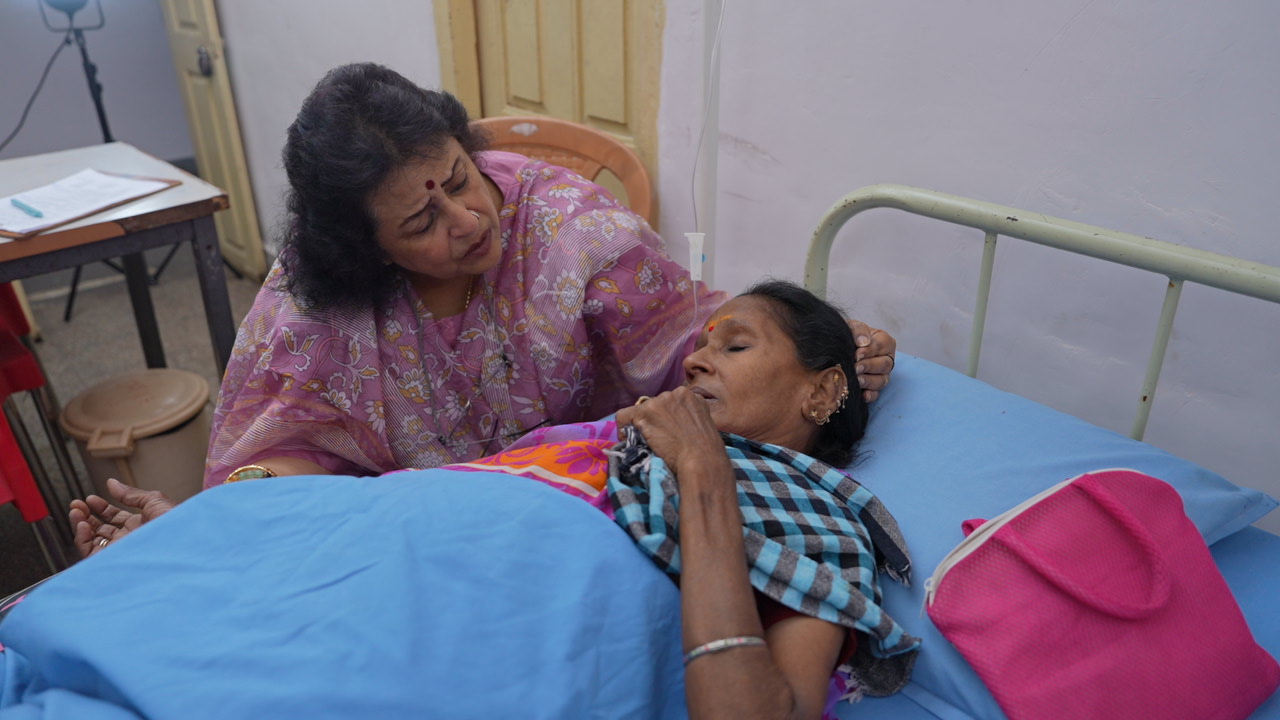
Some of DEAN Foundation’s patients live in a plastic shack, a hut, or on the pavement. A doctor and nurse team still reaches them, every day.
Elderly care for poor families or Palliative care in India reaches only a handful of the people who need it. Medical treatment that eases pain and other distressing symptoms in people with serious or life-limiting illness is far harder for poor families than one could imagine. An elderly couple, many of whome might be surviving alone with no means of livelihood, struggle for two square meals in a day. Under these circumstances, how could they imagine getting unaffordable medical care.
What is palliative care, and who needs it?
It isn’t only for the last few days of life. It’s for anyone whose illness can’t be cured and whose symptoms are wearing them and their family down.
DEAN Foundation treats people with cancer, muscular dystrophy, dementia, multi-organ failure, Alzheimer’s, Parkinson’s, end-stage diabetes, renal and heart disease, and those left bedridden by a stroke or a fall. Its free care is aimed at four groups:
- Patients with a terminal or chronic illness
- People who are bedridden and can’t step out of the house
- Anyone in unacceptable pain, or with vomiting, sleeplessness, fatigue or bleeding ulcers for more than 24 hours
- Elderly patients with age-related illness
Roughly 85% of its patients come from very low-income backgrounds, and about half are elderly.
Why does palliative care in India reach so few people?
Partly because nobody wanted to fund it. DEAN’s founder, Deepa Muthaiya, says donors tend to see palliative care as less worthy than educating children or empowering women. That’s a hard sell when the patients won’t recover.
The practical obstacles were just as stubborn. In 2000, getting morphine for pain relief meant licences that were close to impossible to obtain. DEAN worked with Tamil Nadu’s Department of Excise and Drugs Control, and the state’s narcotic rules were amended within six months.
Then came the inspectors. They wanted to see rows of beds, and home-based care was hard for them to picture. Landlords refused to rent clinic space because patients might die there, and because storing narcotics meant handing over property details. Doctors were slow to refer patients, so people arrived late, often in severe pain.
What happens during a palliative home care visit?
The first visit is a full assessment. The team works out what the patient and family need, then writes a care plan.
After that, the work is practical and unglamorous. Nurses and doctors give IV fluids, clean and dress bed sores and wounds, change colostomy bags, insert catheters and look after tracheostomy tubes. They leave enough medicine and supplies to last until the next visit, and follow up by phone in between.
They also teach the family. Caregivers learn how to look after the patient, prevent infection and dispose of medical waste safely.
Teams go out every weekday from three bases: Kilpauk in Chennai, Kancheepuram, and Karamadai near Mettupalayam in Coimbatore district.
Who is behind DEAN Foundation?
Deepa Muthaiya isn’t a doctor. She comes from a family of them, and says she was discouraged from starting a medical charity and not taken seriously by doctors in the field. Her background is in journalism and communication.
She founded DEAN, short for “To Dignify and Empower the Ailing and the Needy”, on 9 March 1998. Her own summary of the work: “If life begins with an act of love why shouldn’t it end that way?”
The numbers, as of 31 March 2023, show what grew from that: 17,790 patients, 64,193 home care visits and 77,072 outpatient services. Of those patients, 13,934 had cancer. DEAN also runs the Department of Paediatric Hospice and Palliative Medicine at the Institute of Child Health and Hospital for Children in Egmore, where it has treated 3,524 children up to age 12. In 2003 Muthaiya became the first Indian to receive the Elisabeth Kübler-Ross Award from Children’s Hospice International.
How much does one palliative home care visit cost?
DEAN budgets Rs 3,500 per patient visit. Here’s where it goes:
Item Cost per visit (Rs)
Medical team consults 1,450
Treatment, rehabilitation and caregiver support 800
Transport (fuel, vehicle upkeep, insurance) 750
Administration 300
Home care delivery support (documentation, phone, equipment upkeep) 200
The treatment line is broader than it sounds. It includes physiotherapy, counselling, nutritional help, lab tests, bereavement visits and funeral expenses.
At 5,000 visits a year, the home care project comes to Rs 1,75,00,000. DEAN’s wider annual budget, covering Chennai, Kancheepuram, Karamadai and its other projects, is Rs 3,06,00,000. Of that, Rs 2,68,00,000 goes to patient care and Rs 38,00,000 to administration, which includes a Rs 15,00,000 fundraising project.
How can you help?
Fund a visit. One home visit costs Rs 3,500, and that single visit means a nurse at a bedside, a wound dressed and a family shown what to do next.
Money isn’t the only way in. DEAN also asks for volunteers to help with admin, make arts and crafts for its Charity Kiosk in Chennai, and run stalls at schools, malls and offices. Doctors can help by referring patients earlier.
Choosing to tread the proverbial road less travelled, Ramon embarked upon a career in journalism and spent over 8 years working for various media organisations. A deeper calling to create a sustainable impact in the lives of the less fortunate compelled him to join the social sector. Ramon is a minimalist at heart and an explorer in spirit.