
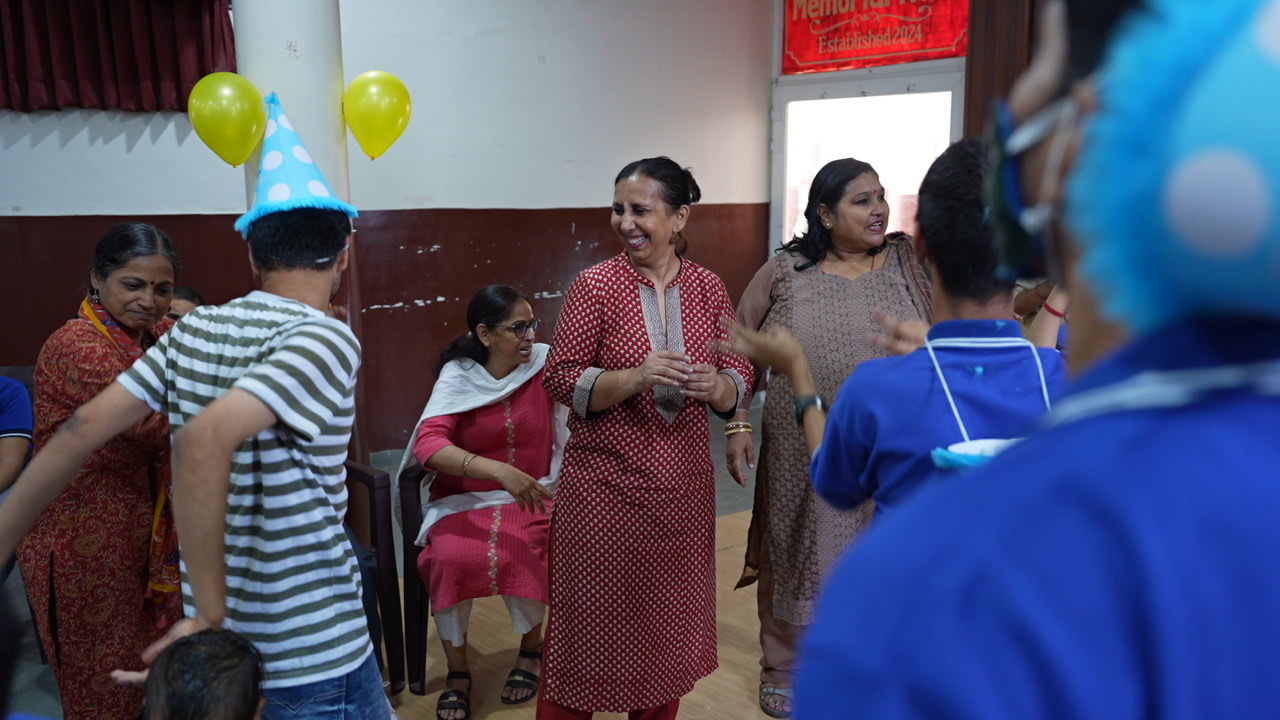
An auto driver from a village near Patna couldn’t afford a train ticket. So he travelled to Delhi without one, carrying his daughter, and took her to National Association for the Blind, Delhi (NAB Delhi).
That was about two years ago. She is now studying at Greenfield, and NAB Delhi’s principal, Nandita Saran, describes her as “so bright”. Her father, Nandita says, made the trip believing NAB Delhi could secure his daughter’s future.
If you want to donate to NAB Delhi, this is what your money pays for. NAB Delhi (the National Association for the Blind) educates and trains children and adults who are blind or have multiple disabilities, and it charges families nothing. Hostel, schooling, uniforms, books, transport: all free.
Free has a cost, though. “Nothing comes free,” Nandita told our team, “but ultimately somebody has to pay the bill.” Here is what that bill covers, and who it helps.
What is NAB Delhi, and who does it help?
NAB Delhi is an organisation that works with children and adults who are blind or have additional disabilities. The youngest are small children learning to pick up a biscuit and eat it on their own. The oldest are adults training to hold down a job.
Nandita has been part of it for 26 years: first as the mother of a child who needed it, then as a volunteer, then as staff. She holds a BA in special education, and she says it has never felt like a job. It’s closer to breathing.
The children are taught by special educators, therapists, counsellors and support staff. None of it is billed to the family.
Why is it so hard for families to find the right help?
Nandita’s daughter has a visual impairment and an intellectual disability. When the family reached Delhi, they hit the wall most parents hit. A blind school will take a child who only has a visual impairment. A setup for intellectual disability will say it has no experience of working with blindness.
NAB Delhi had a Centre for Multiple Disabilities, and for the first time her daughter got attention that was “tailor made” for her. Mother and daughter have been part of NAB for more than 26 years now.
Even the paperwork is a fight. A child with one disability can usually get a certificate from a single doctor. With several, parents go from a neurophysician to an orthopaedic specialist to a psychologist, just to prove what they already know.
Many families also travel a long way before they reach NAB. Parents from smaller cities and villages go to Sankara Nethralaya or AIIMS hoping for a surgery or a course of medicines. When they’re told the answer is rehabilitation, they arrive frightened and sceptical. NAB treats the parents as equal partners, and they draw strength from other parents who have walked the same road.
What does NAB Delhi do every day?
The work is organised into units, each built around a different stage of a child’s life:
- Pre-integration unit. Small visually impaired children learn Braille, sums on the Taylor frame, how to open their own tiffin box and how to move around alone. Without that grounding, Nandita says, a child can get lost in a class of 40. At NAB the ratio is one special educator to eight children.
- Integration unit. For school-going children from class 1 to class 12. Resource teachers reinforce each day’s lessons after school and stay in touch with the child’s teachers. Many of the children live in the hostel.
- Centre for Multiple Disabilities. Every child is assessed individually and gets an individualised education plan. For many, the first goals are daily living skills (eating, toileting) and communicating basic needs.
- Technology centre. A three-month computer and digital literacy course, open to anyone, including adults who lost their sight later in life.
- Livelihood training. Two cafes (one in Dwarka), a cafe training programme, a Braille press, the Srijan handicraft brand, and Surkriti
What does progress look like for these children?
It starts small. A child who couldn’t be separated from his mother learns to open his own water bottle. A fortnight later he picks up his bag at the end of the day and heads for the door. Nandita calls these “a stepping stone towards independence”.
Some children go on to mainstream schools. NAB’s students are admitted to schools around South Delhi, including Greenfield, Tagore, Modern and Kendriya Vidyalaya, and follow the same curriculum as their sighted classmates. Nandita remembers a pair of twin brothers who ran around and lay on the floor during their first visit. She wasn’t sure they’d manage the hostel. They now win best boy awards at Tagore International. She also says students have gone on to jobs in banks, the railways, Google and Microsoft.
For others, the road is different. Pushpa is deafblind and has a degree, but no one would hire her. NAB trained her in handicrafts and in baking muffins and cakes. She now works at NAB’s Cafe Beyond Eyes.
Then there is the cafe training programme. One totally blind young woman had finished computer courses and other training, and still had no job. After the cafe course she was hired by a cafe in Pune. The programme’s slogan is “cooking without looking”. Of the first batch of four trainees, two were employed straight away.
One more. A deafblind boy arrived at eight or nine, frightened, with no vision and profound hearing loss. He’s now over 18 and doing well in the vocational programme. His mother helps with other children there.
“Every child can do something,” Nandita says. The job is to find out what.
Why does NAB Delhi need your donation?
Because nobody pays fees. Nandita puts it plainly: “funding is a huge problem.” Educators work with children at ratios of one to eight, one to four, sometimes one to three. Trained educators, therapists and counsellors are a huge cost, before you count buildings and equipment.
She is also quick to say that NAB isn’t the only place that can help. What she insists on is the principle: never deny intervention services to any child. A child kept at home doesn’t grow out of the problem.
How can you donate to NAB Delhi?
You can donate to NAB Delhi through its page on give.do:
If you work at a company, forward this post to your CSR team. Corporates are one of NAB Delhi’s main funding routes. And if you know a family searching for a place that takes a child with more than one disability, send it to them too.
Nandita’s request is short: help bring a smile to each child’s face. The next family walking into NAB Delhi may not have a train fare either. A donation on the Give.do page is how you make sure that doesn’t matter.

Give exists to alleviate poverty by enabling the world to give. Established in 2000, Give, together with its partners, is the largest and most trusted giving platform in India. Give enables individuals and organizations to raise and donate funds conveniently to any cause they care about, with offerings including crowdfunding, corporate giving, cause marketing, and philanthropy consulting. Give’s community of 2.6M+ donors supports 3,000+ verified nonprofits, serving 15M+ people across the country.