
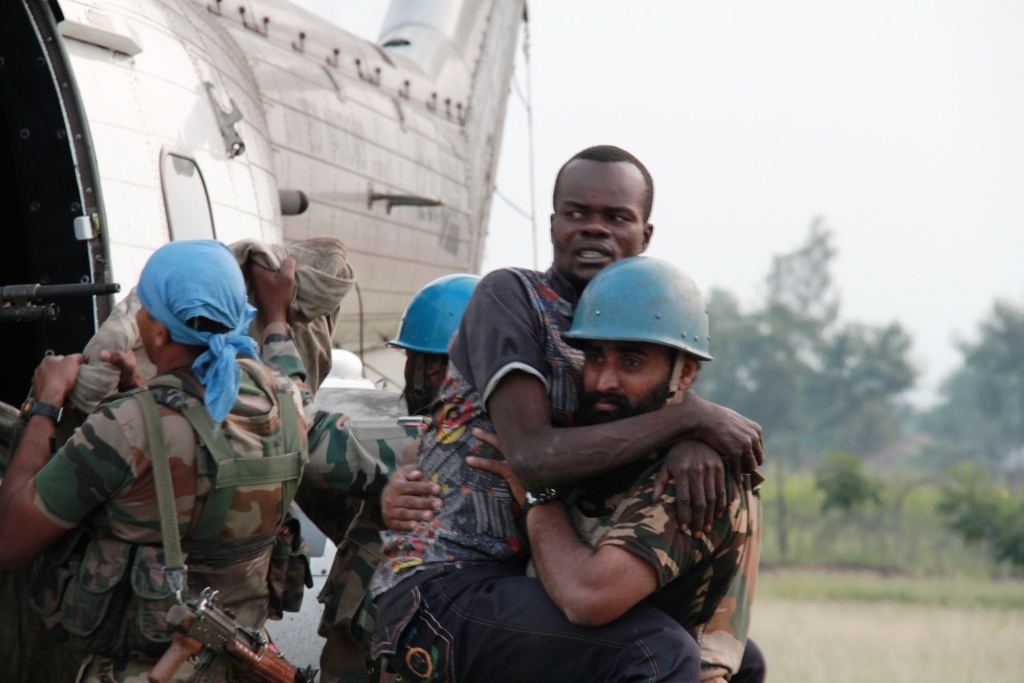
EVERY year on 29 May, the world pauses to mark the International Day of UN Peacekeepers. This year, the pause feels more urgent than ever. On 15 May 2026, the Democratic Republic of the Congo declared its 17th Ebola outbreak. Within hours, UN peacekeeping mission MONUSCO swung into action.
MONUSCO coordinated immediately with the World Health Organisation to rush emergency supplies to Bunia, the epicentre of the outbreak. In just four days, peacekeepers airlifted nearly 20 tonnes of cargo: protective equipment, laboratory materials, medicines, and patient care tents. Two additional cargo flights followed, carrying tonnes of freight from Kinshasa and Nairobi directly into the crisis zone.
But the response didn’t stop at logistics. Military, police, and civilian peacekeepers fanned out into communities. In Tchabi and Fataki, they ran awareness campaigns — teaching residents about hygiene, the dangers of bushmeat consumption, and how to protect themselves and their families. They reached internally displaced persons who had nowhere else to turn. They went where others simply couldn’t.
This is what peacekeepers do. They don’t just monitor ceasefires. They show up — in floods, in outbreaks, in the darkest corners of conflict — and they deliver.
The scale of the mission
Today, more than 50,000 civilian, military, and police peacekeepers serve across some of the world’s most complex and dangerous environments. They protect civilians, monitor ceasefires, enable humanitarian assistance, and neutralise explosive hazards that continue to kill and maim long after fighting ends.
From Liberia and Namibia to Cambodia, Sierra Leone, and Timor-Leste, their presence has been transformative. They have guided nations from the very edge of collapse toward sustainable peace — often without recognition, often without adequate resources.
The International Day of UN Peacekeepers, observed this year under the theme Invest in Peace, is a reminder that this work does not happen automatically. It requires political will, sustained financing, and collective commitment. Peace, as the United Nations reminds us, does not happen by accident.
Yet peacekeeping operations today face shrinking budgets and reduced political backing. The consequences are visible and painful — directly impacting the populations they serve and placing the safety of peacekeepers themselves at greater risk.
More Than 4,500 Lives Given for Peace
The International Day of UN Peacekeepers is also a day of mourning and tribute. More than 4,500 peacekeepers have lost their lives in the cause of peace. This year, 68 fallen peacekeepers will be honoured with the Dag Hammarskjöld Medal — 59 who gave their lives in 2024, and nine from previous years.
Their sacrifice is not abstract. It is measured in families without fathers and mothers, in colleagues who carry the memory of those who did not come home.
The day also recognises trailblazing women in peacekeeping, through the Women Police of the Year Award and the Military Gender Advocate of the Year Award. Gender-responsive peacekeeping is not a footnote — it is central to the mission’s effectiveness and credibility.
India and the Blue Helmet
The UN peacekeepers are known the world over by their light blue helmets — a colour chosen in 1947 because blue symbolises peace, in deliberate contrast to the red so often associated with war. No nation has worn that blue helmet more than India.
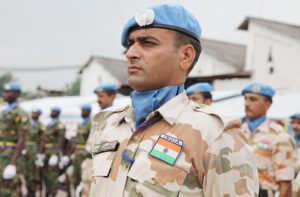
Since the 1950s, India has contributed over 290,000 peacekeepers to more than 50 missions worldwide — making it one of the largest contributors to UN peacekeeping in history. Today, over 5,000 Indian troops serve in nine of the eleven active missions, often in the most dangerous and hostile regions on earth. Nearly 180 Indian peacekeepers have made the ultimate sacrifice in this pursuit.
India’s commitment to peacekeeping runs deep. It flows from the ancient principle of Vasudhaiva Kutumbakam — the whole world is my family — and from a national philosophy shaped by Mahatma Gandhi’s belief in non-violence. These are not merely ideals. They translate into boots on the ground, in some of the world’s most volatile places.
India has deployed troops and officers across missions in Côte d’Ivoire, Afghanistan, Cyprus, Western Sahara, South Sudan, and the Democratic Republic of Congo, among others. Beyond deployments, India actively supports host nations through training, infrastructure development, and Civil-Military Coordination programmes. Indian Army Veterinary Detachments have even provided humanitarian support to local communities in mission areas — a quiet but meaningful expression of care that goes well beyond the mandate.
India has also taken a lead on gender inclusion in peacekeeping. In February 2025, the Centre of United Nations Peacekeeping hosted the Conference on Women Peacekeepers from the Global South in New Delhi, bringing together women peacekeepers from 35 nations to discuss strategies for greater participation and effectiveness. It was a powerful signal of India’s commitment to making peacekeeping more inclusive and more capable.
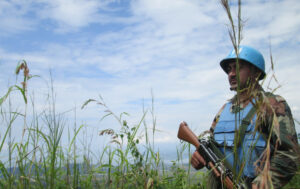
India’s contributions have been recognised at the highest level. In 2023, the country received the Dag Hammarskjöld Medal posthumously for three of its own — peacekeepers Shishupal Singh and Sanwala Ram Vishnoi, and civilian UN worker Shaber Taher Ali — who gave their lives in the Democratic Republic of Congo.
An Indian Officer’s Remarkable Final Chapter
Among those who have given decades to this cause is Lieutenant General Mohan Subramanian of the Indian Army — a soldier who completed 40 years in uniform before stepping down earlier this year as Force Commander of the UN Mission in South Sudan (UNMISS).
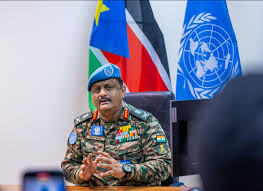
On 26 February, he conducted his final Honour Guard inspection in Juba. Colleagues gathered from across the mission to bid farewell to a leader who had become synonymous with steadiness under pressure. Since 2022, General Subramanian had navigated South Sudan through historic flooding, persistent violence, and the constant strain of an underfunded mission. He travelled extensively into the country’s most volatile regions — not from behind a desk, but alongside his peacekeepers, on the ground, in the field.
In his farewell address, he issued a quiet but powerful challenge to those who question the value of peacekeeping:
“Whenever somebody asks me what have you done — I ask them, would you care to spend two hours with me? Recount what would have happened if we were not there. Then give me two hours to tell you what we have done. And at the end, if you don’t go back with a salute to UNMISS, I will change my name.”
He also offered a clear-eyed assessment of what peacekeeping means to the international community:
“United Nations Peacekeeping remains the most reliable, most credible, most cost-effective tool in the toolkit of the international community to achieve international peace.”
General Subramanian’s retirement closes a remarkable chapter. But his words — and his career — stand as a testament to India’s enduring contribution to the blue helmet mission.
Now Is the Time to Invest in Peace
Eighty years after the United Nations was founded on the belief that peace is possible, the International Day of UN Peacekeepers calls on every nation to act on that belief — not just with words, but with resources.
Investing in peace saves lives. It prevents wider conflict. It reduces the far greater humanitarian and financial costs that follow when peace collapses entirely. Every dollar committed to peacekeeping returns multiples — in stability, in protected lives, in futures made possible.
On this International Day of UN Peacekeepers, we honour those who serve in silence, in danger, and in faith that their presence makes a difference. We mourn the more than 4,500 who gave everything. We salute Lieutenant General Mohan Subramanian and the hundreds of thousands of Indian peacekeepers who have carried their country’s deepest values across the world.
And on this International Day of UN Peacekeepers, we echo the United Nations’ call with clarity and conviction:
Now is the time to invest in peace.

Give exists to alleviate poverty by enabling the world to give. Established in 2000, Give, together with its partners, is the largest and most trusted giving platform in India. Give enables individuals and organizations to raise and donate funds conveniently to any cause they care about, with offerings including crowdfunding, corporate giving, cause marketing, and philanthropy consulting. Give’s community of 2.6M+ donors supports 3,000+ verified nonprofits, serving 15M+ people across the country.