
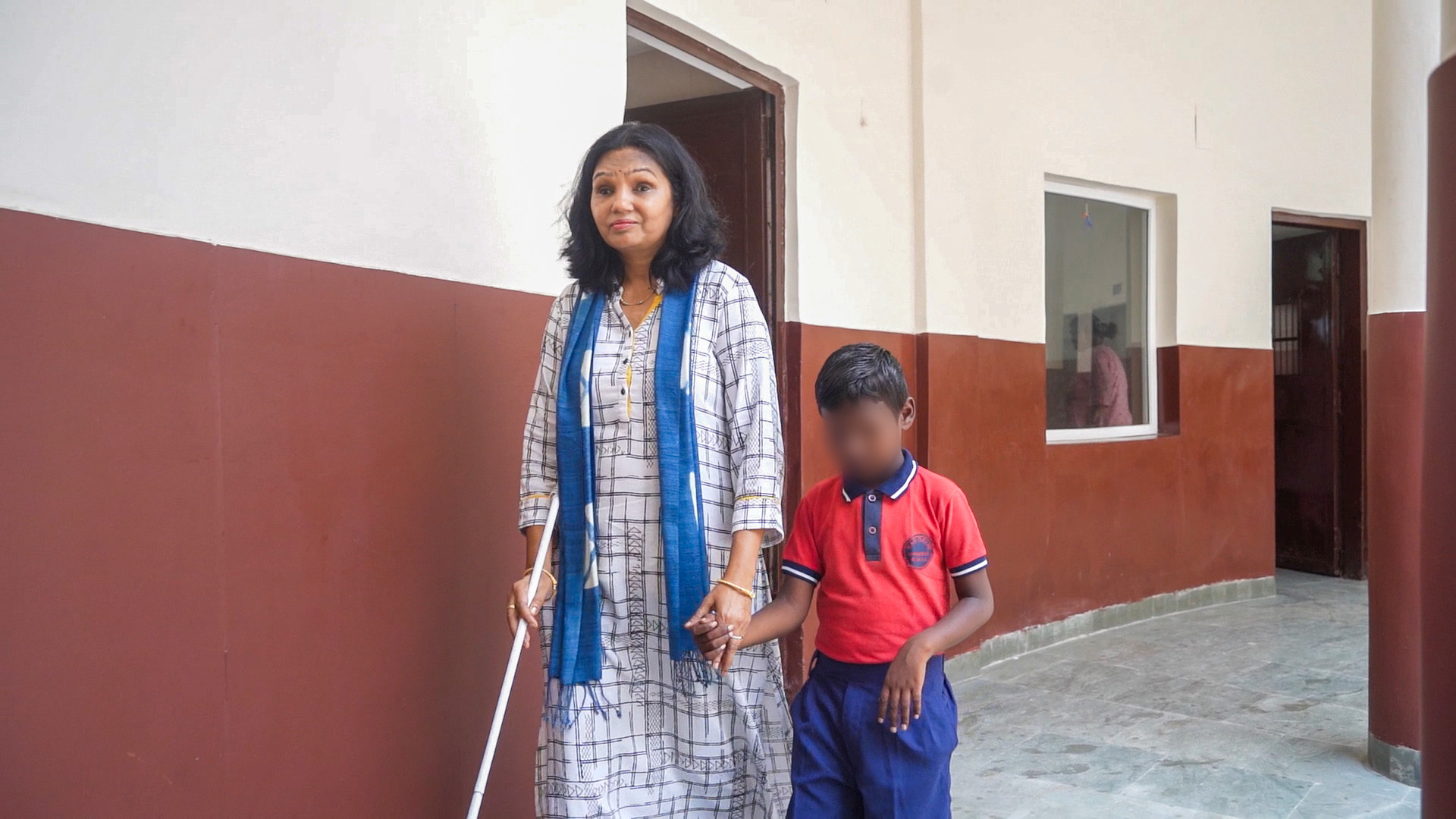
IN India, every child with a benchmark disability has a legal right to free education between the ages of six and eighteen. So why do so many families of blind children still struggle to keep them in school?
Because tuition is only one line on the bill. The real cost of education for blind children sits around the classroom: braille books, assistive devices, safe travel and trained support.
This post breaks down where that money goes, what the government already covers, and where a donor’s rupee makes the biggest difference.
Is education for blind children really free in India?
On paper, largely yes. Section 31 of the Rights of Persons with Disabilities Act, 2016 says a child with a benchmark disability has the right to free education in a neighbourhood school or a special school of their choice. A benchmark disability means a certified disability of at least 40 per cent.
The Act also asks government-funded and government-recognised schools to provide inclusive education. That’s the promise.
But a free seat isn’t the same as education for blind children that actually works. A blind child in a mainstream class needs the textbook in a format they can read, a teacher who knows how to help, and a way to reach the school gate every morning. None of that comes with the admission form.
Special school or mainstream school: does the cost change?
It does, though not in the way most people expect. A special school for blind and visually impaired children usually bundles braille teaching, mobility training and hostel life under one roof. The costs are concentrated in one place.
A mainstream school keeps the child close to home and to sighted classmates. However, education for blind children in a mainstream class still needs extra support, and someone has to pay for it. That someone is usually the family or an NGO.
What does school support for visually impaired children actually cost?
The fee may be waived. Almost everything else still has a price. These are the main cost areas that families and NGOs deal with every year.
Braille books and learning materials
A sighted child opens a printed textbook. A blind child needs the same book in braille, large print or audio. Braille is bulky, so a single textbook often runs to several volumes.
Then there’s the writing kit: a slate and stylus, or a braille writer, plus paper sturdy enough to hold the dots.
Assistive technology
Older students rely on screen-reading software to use computers and phones on their own. The software is only half the story, because the device has to be reliable too. A laptop that fails during exam week is a real setback.
Travel and escort costs
Many blind children can’t make the journey alone at first. Someone has to walk them to the bus stop, or a parent skips a day’s wages to do it. In a family living on daily earnings, that hidden cost can decide whether a child attends at all.
Specialist teaching and mobility training
Braille takes trained teachers. Orientation and mobility training, which teaches a child to move through a building or a street with a white cane, takes trained instructors. Where a mainstream school has neither, an NGO often pays for both.
Everyday school costs
Then come the ordinary items: uniform, bag, stationery and, for children who live in a hostel, food and a bed. Individually, they’re small. Across twelve years of education for blind children, they add up.
So what’s the total? It varies by city, by type of school and by whether the child boards.
What happens when the support isn’t there?
A child rarely leaves school in one dramatic moment. It’s slower than that. The braille textbooks arrive three months into the term. The bus fare runs out in week six. The one teacher who knew how to help moves to another school.
Each gap is small, so nobody calls it a crisis. But a child who can’t read the day’s lesson falls behind, and a child who falls behind often stops turning up. That’s why education for blind children depends on steady support, not a single big grant.
Which government schemes offer education support for blind children?
The Department of Empowerment of Persons with Disabilities runs a pre-matric scholarship for students with disabilities in classes 9 and 10. It combines a monthly maintenance allowance, a book grant and a disability allowance.
Scholarships for later years also exist. They’re worth applying for, and they do help.
But applications aren’t simple. Families need a valid disability certificate, identity documents and bank details, and the money often arrives after the expenses do. As a result, a scholarship helps but doesn’t always cover the full gap.
Why do families still need education support for blind children?
Because a right on paper still needs someone to deliver it. Government schemes set a floor, but a child’s day-to-day needs change faster than the paperwork does. A new class means new books in a new format. A new school means learning a new route.
NGOs that run education programmes for blind children often step in at exactly these points. They buy the braille books, pay the escort, train the teacher and sit with the family through the scholarship forms. Most donors never see that work, yet it’s what keeps a child in class.
How does a donation fund education for blind children?
A donation to a verified NGO on Give.do goes straight towards the cost lines above, and towards education for blind children in particular if you choose a programme that serves them. One child’s braille materials for a year. A teacher’s time shared across a class. A white cane and the mobility training that comes with it.
Before you give, it helps to ask four plain questions of any NGO working on education for blind children:
How many children does the programme support, and in which classes?
What share of the budget goes to braille materials and assistive devices?
Who pays for travel and escorts?
Are there trained braille teachers on staff, or only volunteers?
An NGO that has the answers to hand usually runs a tighter programme. If the answers are vague, ask again.
Donations to eligible NGOs may also qualify for tax benefits under Section 80G. Rules change, so check current guidance and the NGO’s registration before you claim.
What can you do today?
Start by choosing an NGO that provides education support for blind children on give.do
Browse verified education NGOs on Give.do, pick one cost line and fund it.
Choosing to tread the proverbial road less travelled, Ramon embarked upon a career in journalism and spent over 8 years working for various media organisations. A deeper calling to create a sustainable impact in the lives of the less fortunate compelled him to join the social sector. Ramon is a minimalist at heart and an explorer in spirit.