
Building joyful and empowered children in rural Madhya Pradesh in a focused way - SPORTS I WELL-BEING I TECHNOLOGY
Campaign by Mrida Education and Welfare Society
Donate Via
Google Pay, Paytm and others
Credit & Debit Cards
Internet Banking & Transfer
Story
Mandla is a densely-forested district surrounded by river Narmada and is dominated by the Gond and Baiga tribes. With small landholdings that have been losing productivity that has resulted in food insecurity and subsistence income, the people relied on the non-timber forest produce (NTFP) to support their livelihoods. The earnings from NTFP too have been failing in recent years due to climate change and rejection of forest rights claims. As a result of the welfare programs not reaching the people effectively, the district of Mandla as a whole has weak human development indicators.
A 2005 State Planning Commission report had estimated that 75.5% of the population in the district of Mandla were below the poverty line. Mandla’s urban population accounted for only 12.3%. As per the National Family Health Survey (2015-16), in Mandla, 49.8% of children were underweight, while 36.9%, 44.5%, 69.7% suffered from stunting, wasting, and anemia respectively. As per the 2011 census, the average literacy rate among the total population was 63% against 51% literacy rate among the scheduled tribes that accounted for 57% of the population.
Forced by chronic poverty, during lean seasons, the tribes migrated to nearby villages and towns in search of work. The seasonal migration of parents in search of work affected the children’s schooling, and an estimated 45% of the students enrolled in the school did not attend school regularly. Food insecurity impeded families from spending on education and drove children to enter the workforce before they completed the education, where they did not fit and suffered poor working conditions and job loss. Thus, they remained trapped in a vicious poverty cycle. Even among children who complete schooling, there is a lack of skill attainment, particularly important to households living below the poverty line.
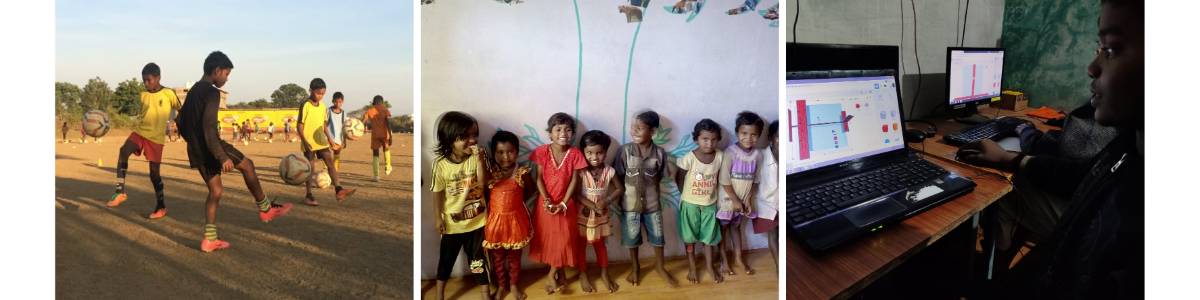
Founded in 2016, Mrida has been working with tribal children from 4-16 years through a model that emphasizes care, skilling, and well-being. Currently, we have 210 children with 110 living in the shelter home, who come from Gond and Baiga families with an average annual household income of Rs.30,000. Over time, we intend to work with 750 children from some of the poorest tribal families in the region. Through this, we intend to influence and eventually reach many more children in the region.
SPORTS:
The structured curriculum I AIFF-certified coaches I All age groups
WELL-BEING:
Balanced diet and care I Basic schooling
FUTURE TECHNOLOGY:
Computers I Tinkercad I Python I AI I GIS
Our entire team that includes alumni of India ' s premier colleges who all live and work out of Mandla.
In 2020-21, the total number of children who will benefit from our schooling will be 253 with 133 being day scholars. Through intensive and selfless work with a group of at-risk first generation tribal learners, we wish to demonstrate that excellence can only be achieved through sustained effort
Impact in the next 2 years:
- Weight gain among children who are under our complete care with a strong improvement in BMI indicators.
- Rooting out of anemia currently present in nearly all children who have been in the shelter home for less than 1 year.
- All children in the shelter home learn self-care and hygiene.
- Well-defined livelihood pathways and related activities for every child.
- Children start coding using Python.
- A well-trained and accomplished under-14 football team that has experienced success in local, regional and pan-India tournaments.
- An under-14 girls football team.
- Developing child farmers through practical farm-based work.
- All children are grade-ready within 2 years.
Impact in the next 5 years
- Healthy, well-rounded and focused children living in the shelter home.
- Strong academic results for children on the academic track.
- Developing child farmers and entrepreneurs who will through sustainable farm practices, be able to earn and provide a livelihood to others.
- Creating a vibrant and dynamic grassroots sports program for all tribal children in Mandla and Dindori districts.
- Creating a strong technology program with 60% of children involved in this, picking STEM-related fields.
Organisers

Mrida Education and Welfare Society
Beneficiary Charity

Mrida
Organiser
Start a Supporting Fundraiser
Magnify your impact by starting your own fundraiser. All funds raised by you will support the cause and help reach the goal faster.
View All Donations
India's most trusted online donation platform

Easy
Donate quickly and seamlessly

Impactful
Champion causes close to your heart and change lives

Credible
Support 3,000+ certified Indian nonprofits
FAQs
Everything you need to know about the product and billing. Can’t find the answer you’re looking for? Please chat with our friendly team.
How does give.do Fundraisers work?
Is my donation on Give.do Fundraiser secure?
Will my entire donation reach my selected NGO?
What payment methods are accepted on Give.do?
In what currencies does Give.do accept the donation?
What causes can you donate to?