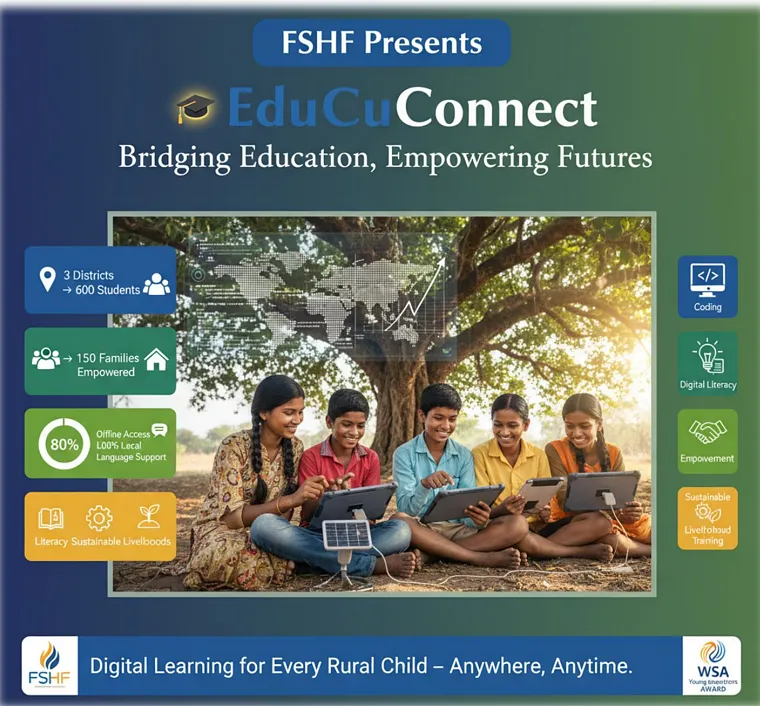
EduConnect: Bridging Education, Empowering Futures
Story
 Project Details
Dear Members of the WSA Young Innovators Jury,
On behalf of Fulminare Social Help Foundation (FSHF), we are honored to
present our proposal titled “EduConnect: Bridging Education, Empowering
Futures” under the category of Education & Digital Literacy (SDG 4).
EduConnect is a digital innovation that merges inclusive e-learning, digital
literacy, and sustainable livelihood training to empower rural and tribal
youth across Bihar, Uttar Pradesh, and Jharkhand. Through an app and web
portal that functions even offline, we aim to bridge the digital divide and
ensure no child or young adult is left behind due to lack of connectivity or
opportunity.
As an NGO rooted in community transformation and inclusive development
since 2020, FSHF has consistently focused on education, climate resilience,
and women’s empowerment, impacting over 10,000 lives. This proposal
builds on our past success and our vision for a future where technology
becomes the bridge between disadvantage and opportunity.
We thank you for the opportunity to share our vision and look forward to
the chance to collaborate under the WSA Young Innovators framework to
scale EduConnect globally.
Executive Summary
EduConnect: Bridging Education, Empowering Futures is an integrated digital
education platform created by Fulminare Social Help Foundation (FSHF) to address the
persistent issue of digital inequality and limited access to quality education in India’s rural and
tribal communities.
EduConnect provides:
❖ Interactive e-learning modules in core academic subjects, digital literacy, and coding.
❖ Skill-building courses focused on sustainable livelihoods and 21st-century skills.
❖ Offline access for areas with poor connectivity, ensuring inclusivity and accessibility.
This project seeks to empower 600 rural youth and children in its pilot phase, equipping them
with both academic and practical skills to improve employability, social inclusion, and digital
participation. EduConnect directly contributes to UN SDG 4 (Quality Education) and
indirectly supports SDG 8 (Decent Work) and SDG 10 (Reduced Inequalities), building a
scalable model for equitable digital education across India.
Background
Rural and tribal children often face severe barriers to education due to poverty, poor
infrastructure, and limited digital access. EduConnect bridges this gap through technologyenabled learning solutions that are culturally relevant, offline-accessible, and easy to use.
Goals
❖ To ensure digital inclusion by delivering education through accessible platforms.
❖ To improve digital literacy and coding skills among rural youth.
❖ To promote sustainable livelihood training for employability and entrepreneurship.
Key Features and Innovations
1. Offline-first Learning App: Allows users to download lessons once and access them
without internet.
2. Interactive E-modules: Audio-visual lessons in Hindi, English, and local dialects.
3. Skill Workshops: Hands-on coding, digital marketing, and eco-friendly enterprise
training.
4. Teacher Dashboard: For monitoring student progress and local mentorship.
5. Data-driven Analytics: Measuring progress and impact in real-time.
Problem Analysis and Rationale
Context
According to the National Sample Survey (NSS 2023), nearly 68% of rural households in
India lack regular internet access. Digital literacy rates remain below 30% among rural youth,
especially in Bihar and Jharkhand.
The ASER 2022 report highlights that rural students face poor learning outcomes due to
school closures, infrastructure deficits, and lack of digital resources.
Local Need
In our project areas, surveys conducted by FSHF (2023–24) show:
❖ 72% of rural youth do not have access to e-learning tools.
❖ 60% of students drop out before completing secondary education.
❖ Teachers face training gaps in digital education delivery.
Alignment
EduConnect aligns with:
❖ UN SDG 4: Quality Education for All
❖ UN SDG 8: Promoting lifelong learning and employability
❖ ESG Principles: Inclusion, innovation, and sustainability
Implementation Strategy and Work Plan
Step-by-Step Plan
1. Phase 1 – Preparation (Month 1):
• Curriculum design with experts.
• App and offline architecture planning.
• Community awareness campaigns.
2. Phase 2 – Development (Month 2):
• Platform development and testing.
• Translation of modules into local languages.
3. Phase 3 – Pilot (Month 3):
• Pilot testing in 10 schools/villages.
• Collect feedback and improve UX/UI.
4. Phase 4 – Full Implementation (Months 4–5):
• Launch in 3 districts, train 600 youth.
• Conduct workshops for teachers and mentors.
5. Phase 5 – Monitoring & Evaluation (Month 6):
• Track progress using dashboards.
• Community review and final reporting.
Impact, Outcomes & Monitoring
Expected Outputs
❖ 600 youth trained in digital and coding skills.
❖ 60 teachers and mentors trained.
❖ 150 households benefiting from digital education indirectly.
Outcomes
❖ Improved digital literacy (measured via pre-post tests).
❖ Increased employability through coding and online work.
❖ Strengthened school-community partnerships.
Monitoring Framework
❖ Tools: Digital dashboards, field surveys, mentor reports.
❖ Indicators: Module completion rate, attendance, skill proficiency, satisfaction index.
Risk Management & Sustainability
Risks & Mitigation
Risk Mitigation
Poor connectivity Offline modules preloaded in tablets
Low engagement Gamified content and community competitions
Staff turnover Volunteer backup and capacity building
Sustainability Plan
❖ Integrate with local schools for long-term adoption.
❖ Seek CSR and government education partnerships.
❖ Generate partial revenue via premium vocational modules.
Detailed Budget (INR)
Category Unit Cost Quantity Subtotal Remarks
Platform & App
Development 150,000 1 150,000 App + offline mode
Content Creation (20
Modules) 25,000 20 500,000 Videos, quizzes,
PDFs
Trainers & Staff
Salaries (6 months) 30,000 6 180,000 Project team
Workshops & Training 6,000 20 120,000 Includes venue,
food, materials
Equipment (Tablets,
projectors) 9,000 30 270,000 For training and
classrooms
Communication &
Promotion — — 40,000 Posters, local
media
Monitoring &
Evaluation — — 35,000 Data collection
tools
Travel & Logistics — — 25,000 Staff travel, field
monitoring
Contingency (5%) — — 66,000 Risk buffer
Grand Total: 13,86,000 INR (~USD 16,500)
Future Plans
After the pilot:
❖ Expand EduConnect to 10,000 learners across five states.
❖ Integrate AI-based personalized learning.
❖ Partner with NCERT and EdTech companies for certification.
❖ Launch multilingual content for Pan-India scalability.
Conclusion
EduConnect is not just a digital tool — it’s a movement to democratize education, giving
every rural child the right to learn, grow, and lead in a connected world.
By supporting this initiative, the WSA Young Innovators Award will enable FSHF to turn rural
digital isolation into empowerment, shaping India’s next generation of innovators.
Together, we can transform education into a bridge between potential and possibility.
“If you join us, we can also support any plans or projects you have in India or
Nepal, we are helping you to achieve your goals with our expertise and resources.”
For further discussion, please contact:
Contact person: RAHAT SAHU – Chief Development Officer
Fulminare Social Help Foundation (FSHF)
Donation Deadline
Friday, December 25, 2026
Project Website
https://fshfoundation.orgProject Location
vill rehari, post barhari,ps karghar,SASARAM Rohtas,
Rohtas,
Bihar 802215
India.
Organisers

Fulminare Social Help Foundation
Beneficiary Charity

Sumit kumar
Organiser
Start a Supporting Fundraiser
Magnify your impact by starting your own fundraiser. All funds raised by you will support the cause and help reach the goal faster.
0 raised of 2.5L
View All Donations
India's most trusted online donation platform

Easy
Donate quickly and seamlessly

Impactful
Champion causes close to your heart and change lives

Credible
Support 3,000+ certified Indian nonprofits
FAQs
Everything you need to know about the product and billing. Can’t find the answer you’re looking for? Please chat with our friendly team.
How does give.do Fundraisers work?
Is my donation on Give.do Fundraiser secure?
Will my entire donation reach my selected NGO?
What payment methods are accepted on Give.do?
In what currencies does Give.do accept the donation?
What causes can you donate to?